26:34 MINS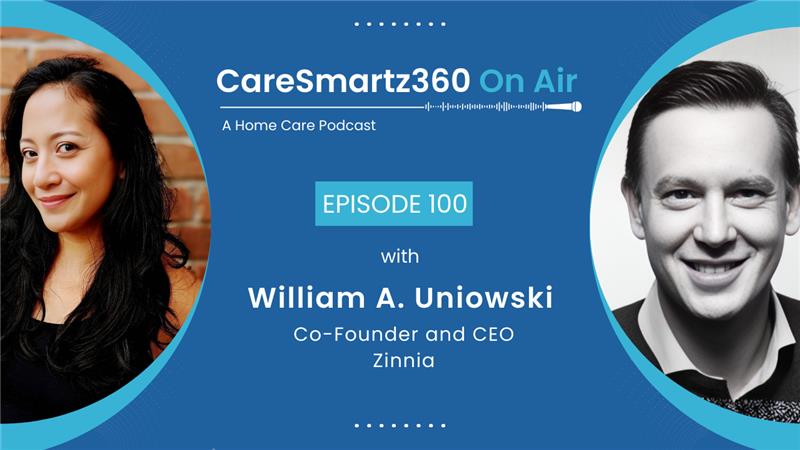
Join us as we welcome William A. Uniowski, Co-Founder and CEO of Zinnia, a dementia support platform designed to ease daily caregiving challenges through research-backed, human-centered tools.
With deep experience across caregiving, technology, and dementia research, William shares practical strategies to support caregivers, and strengthen meaningful connections for individuals living with dementia. In this episode, he explores how agencies can train caregivers effectively, improve family communication, and thoughtfully integrate technology and AI without losing the human touch.
Trusted by 1,000+ Leading Home Care Agencies


00:00:10
Hello and welcome to CareSmartz360 On Air. My name is Carolina Gonzaga and I’m one of the Sales Executive here at Caresmartz. Today, I’m very honored to be joined by William A. Uniowski. I’m so excited to welcome you, Will. Welcome to the CareSmartz360 On Air podcast. >> Thank you so much. It’s great to be here. Yeah, I’m excited to talk to you because I recently learned of what you do. So, Will, I want to get to know you. I want to get to know, you know, all about your company and what you do. And
00:00:40
I’d love to just start by you explaining exactly what Zinnia is for our listeners. >> That’d be great. So, Zinnia is a streaming service just like YouTube or Netflix, but all of the content has been built specifically for people living with dementia. So, we have a wide variety of topics and interests and videos to help connect with people on a personal level and their interests. And they’ve all been built to be digestible by and engaging for people living with dementia. So, think slow moving, gently
00:01:12
paced, free of plot and dialogue, but still very visual with sound effects and things like that to really capture people’s attention and engage them. Um, and really what this turns out to be is a tool for caregivers to use to help manage the behavioral and psychological symptoms of dementia as well as reducing their own care burden as a caregiver. And we work all across the care continuum from family members at home into senior living and adult day and home care as well as some hospitals. And
00:01:43
people use us to reduce agitation, redirect uh someone with dementia who might be upset, you know, bring them towards something they like and something they enjoy. Um helps to engage, sit down, watch it together, spend time creating conversation and reminiscence, which is great, finding moments of joy. or as a caregiver, if someone is so engaged by the thing that they’re watching, you can take 10 minutes and take a quick shower, you know, clean up around the house or do things that you know, you might be might
00:02:11
be piling up. And then also, we’ve created content around activities of daily living. So, a common thing with people with dementia is they might be resistant to doing things like drinking water or going to bed or getting dressed or taking a shower. And we have videos that model, prompt, and cue those behaviors uh to make it easier for the caregiver and the person they’re supporting to accomplish what they need to. And all of this has been validated through research. Um we’ve done two
00:02:37
years of research with the University of British Columbia and Vancouver General Hospital in Canada, resulted in published papers in peer-reviewed journals, and we’re always doing more research to to validate and get better and improve our product. >> Amazing. Well, I love to hear that you’re working with the University of British Columbia because I was born in British Columbia. Just a little side note for everyone. Amazing. So, before we kind of get I have a lot to ask about this is so um specific. It’s so needed.
00:03:04
So, tell me I’m interested to know, Will, how did Zenia become what it is today? What was your kind of career journey? Maybe the experience has led to its creation. >> Sure. Well, on a personal level, you know, I never did anything in care um for a while for my career um until uh Zenia and I had been doing traditional banking finance stuff. I’ve done uh startup media things and that’s what kind of got me connected to the team um that ended up building Zinnia and and really the story of Zinnia is the story
00:03:38
of my co-founder Allison. She was a family care partner to her husband Evan who was diagnosed with front temporal dementia at the age of 47. Okay. >> So, she was thrust into caregiving um and wanted to do the best she could for him in all aspects. And that turned into educating herself on dementia and turning that into a profession with dementia education. And what she discovered is she’d go visit Evan in a community and sometimes his wheelchair would be pushed up against the TV
00:04:06
watching something he never would have chosen to watch. It’s what the caregivers wanted to have. and it didn’t move at a pace that was able for him to digest and understand what was going on. It was a topic that didn’t connect with him. It might have been triggering or upsetting and he would get agitated and it broke her heart to see this. And so she thought there’s got to be something better. And she looked into, you know, the published research about what good media is for people with
00:04:31
dementia. and there wasn’t a ton, but what was out there indicated that something that was slow moving, gently paced, connected to someone’s background and interests was positive. So, she started making little videos on her phone using photos of their kids and their dogs and their trips and thought, “This is really working well. I sit with Evan, we look at the pictures, we talk, we reminisce, we enjoy our time together.” But he also liked to ski and hike and things like that. She didn’t
00:04:59
have skiing and hiking things on her phone. And so that was sort of the moment of what if we created this big platform with lots of different topics, hundreds of videos, um, beautiful, visual, interesting to people, researchbacked um, at a good pace for people with dementia and make it available. And so that’s what we did over and over . It was a passion project for four years. We just would build content and test it and that’s when we did our research. um over time has turned into a business.
00:05:29
>> That’s amazing. And in a um I’m just curious because I hear so many or I’m starting to imagine that there’s so many ways that this can be used. Um you know, you mentioned maybe a caregiver that’s one-on-one or a family circle or maybe even a community. Um and so where do you find right now that Zinnia is being utilized the most? Are people finding it kind of in their own kind of day-to-day lives or is it more kind of being scaled on a larger level today? >> It’s it’s it’s all over. It’s
00:05:59
everything. Um, you know, word of mouth is super powerful. People will be using Zinnia and share it with the members of their support group. Um, >> yeah, >> senior living staff will move to a different community and tell their new community, hey, we had Zinnia at this and this is really good. We should really check it out. It was helpful to our team. The families loved it. So, it’s really grown organically. Um, you know, we spend a lot of time getting the word out and working with various uh people and
00:06:28
ways to do that and building relationships. Um, but lots of different ways to use it, one-on-one, one to many. Um, you know, it’s great for activities content in a kind of a structured adult day or senior living environment. It’s great for families. Sometimes they just have it on in the background and it helps keep a calmer day or you know we do we hear from people who they’re caring for a loved one but they’re still working and they work from home and so it it it kind of keeps that person
00:06:56
occupied and gives them a little time to get stuff done for work. The best way to use it the way that we think is is that the research also shows that if you’re going to consume media with someone with dementia, do it with them. Make it a shared activity. Watch it together. Um, not always that, you know, sometimes it’s great and you need a bit of rest, but watch it together, have a conversation. If mom loved to sew, watch our sewing video and talk about, you know, the the projects and the the costumes that she would make,
00:07:27
and you’d see people sewing and fabric and um threads and all sorts of things. There’s so many different ways to go in that way. Um >> but also you know the activities of daily living are really great if someone you know isn’t drinking water and that’s what happens commonly in dementia. So >> we have users who you know every day at 11:00 they pour glasses of water, they watch the video and they drink water together. So just a lot of different ways to to use it to to make the most
00:07:58
out of it. Even if all you do is put it on and have that on instead of the news or, you know, other triggering topics and crime dramas and, you know, I hear all sorts of things that people watch. Um, if that’s all you use Zia for, you’re already making a better getting a better outcome. But if you’re intentional about how you use it, how you choose what to watch with the person, um, it’s even better. >> I love the idea of this. And you know my my mother does not have dementia but she
00:08:27
has some um you know impairment cognitively. And recently I realized well she sent us all in a very very AI it was a very obviously fake video from YouTube. So for hours of the day like she has a caregiver but for like the caregiver can’t sit with her next to her every day. She’s on her device and messaging the kids. And I tried to convince her and showed her that this was a synthetically created video. It’s not real. This is not really happening. And I just have to tell you, Will, it
00:09:01
really upset me. It really scared me. And so, do you find that there is more of a demand for this? Is this type of thing kind of the reason for the growth of this demand out there that there’s fake stuff out there that might be upsetting or not even real and not even based in reality? There’s no intentionality behind what they’re consuming. Yeah, I think um you know one of the things that happens when with dementia your brain’s just processing more slowly and sometimes people can’t understand
00:09:31
fact from fiction, right? >> And so they see something you know whether it’s AI synthetic or it’s you know a television show and they think what’s happening on the TV is happening to them in real life. >> Um and so you know to have a trusted environment where all of the content is appropriate um it is a real benefit. you know, YouTube. Could you find slow-moving nature videos on YouTube? Sure. But you never know when it’s going to be interrupted by a commercial, what that
00:09:59
commercial is going to be. You don’t know what the next video that will play in autoplay sequence will be and whether it’s relevant and appropriate for people. >> So, um, you know, for people who want a you know, a safe, dementia friendly, calming, gentle viewing experience, Zinny is a trusted way to do that. >> Yeah, for sure. And you’re right about what comes next because oh my goodness is that my daughter, you know, we let her sit in front of the TV and now she’s saying it’s as if I don’t like and
00:10:27
describe that I don’t love my parents. I’m thinking wow and I actually will. I thought it was fake like she made it up and then I brought it up at her birthday party and the parents said oh my gosh my kid told me the same thing. So there’s definitely no rhyme or reason. Well there is a rhyme or reason but there the algorithm is not doing is not meeting the needs of that person that’s watching. Um, my question for you as well is when you brought up your business partner and
00:10:54
like the specific type of dementia, this was somebody that was younger, frontal lobe, maybe some aggression happening at that beginning. So, really needing to protect, you know, that space for him. How has the research done for you guys to kind of diversify because dementia, Alzheimer’s, again, not the same in anyone, but then very different streams as well. So what have you learned or what approach are you taking so that people can kind of navigate what’s going to be the most helpful for
00:11:22
their specific diagnosis? >> Yeah, we recognize that there’s many different dementias and they all present differently and there’s different causes and differences but what we found also within a certain dementia, you know, Alzheimer’s, not everyone has the same experience. So within the dementia world, we often say if you’ve met one person with dementia, you’ve met one person with dementia. And so, you know, one of the things that we try to use with Zenia to make it applicable to as wide a variety of
00:11:50
People possibly have a large array of topics that are very different. Um, to be able to match with that person and their background and their interests because that, you know, if you can connect with who they were, what they are, what’s still there, um, that could be meaningful. Now, we’re also asked, you know, is this for mid to late stage? like one’s the right stage and that varies as well. You know, I would say that if you know my grandmother was watching The Sound of Music and that
00:12:22
made her happy, by all means, keep doing it. Um, but if there comes a time when regular TV just becomes difficult for someone um or stressful or hard to follow, then that’s a good time to move to Zenia. We also hear from people with mild cognitive impairment, so at a very early stage. and we had a panel with them and we asked them what do you watch on TV and a lot of them say I don’t watch TV anymore cuz it’s just that I can’t follow it or it bothers me and it makes me stressed. Um, so you know,
00:12:54
Even with people who are capable of watching regular TV, sometimes it hits a point where that’s too much. And so we have people who with MCI bought Z themselves and they just like to use it to recharge and like to settle down and calm down and then come back to um, you know, the day. So it really is very flexible. It’s open. and everybody’s different and everyone’s condition is different and so uh we try our best to be as wide uh in topics to to accommodate that.
00:13:25
>> I’m wondering because there’s a lot of talk about just general media like the way that I noticed the other day, Will, that I have a very hard time picking something to watch on my TV even though it’s all streaming. And the other day I noticed I was watching and I used to watch YouTube on my TV and now I just find it more comforting to literally have my computer on my lap and I’m like why am I always wanting a smaller screen? So I’m wondering if you’re seeing kind of the increase of
00:13:56
demand because there’s all of this change happening in the way that media is being produced for the general public. It’s almost like it’s more fast-paced. It’s changed like the rhythm of it. So has there been an evolving of you know like almost do you see a parallel to the changes in greater media to the need of Zinnia um in general? >> You know I think the changes in media that that make content accessible to people at the touch of a button with apps and and streaming you know we
00:14:27
definitely are on that like riding that wave. >> Okay. But really, as far as um you know, people Zenia specifically, it’s just people who have a need. Um you know, as a caregiver, you’re overburdened, you’re stressed out, you’re trying to do the best you can for someone, your loved one or the person you’re caring for. Um but, you know, and you need tools and you need options and you’re trying different things. And so, I think the biggest impediment to people adopting Zinny is
00:14:54
just knowing it exists, >> right? um that there is something out there that I can use and yeah, I’m going to give it a try and gosh, like mom laughed, you know, and and we had a nice little exchange together or I learned something about my dad because we put on the Hawaii video and he told me about his experiences in the Navy and I had never heard that before, you know, like it’s it’s really just about making people aware that this is there and accessible them. It’s a tool. Um, and
00:15:25
you know, and it’s easily accessible. Many people these days have connected TVs, so they can download it from the Roku app store. Um, people have tablets. So, the movement in the media to just make so much content accessible um has helped >> help us grow Zenia. We’ve been able to use apps to reach people. Um, but as far as like that this type and style of content and everything else, less of, you know, >> less of we’re trying to get away from sort of the way things are going with,
00:15:57
you know, stuff and too much stimulation. >> So, with somebody like a caregiver that has somebody they want to provide them with the opportunity to consume content on Zenia, what I’m hearing is that there’s a lot of ways that they can do that. They can do that. So, it is a downloaded app. Um, >> right. So you can go on the web and find Zenia at zineatv.com. You can go on and watch videos on your computer, but we also have apps for tablets. So you can put it on, you know,
00:16:27
an iPad or another tablet. Um and then we also have apps for connected TVs. So, if you’re if you have a Roku or an Amazon Fire or a Google or Android TV or Samsung um or Apple TV, not Apple TV Plus streaming service, but the actual Apple TV box that you know you can use, we’re in all of those app stores and so people can find us there >> when So, I worked in senior living for many many years and there’s always a disconnect between the fruitful programming that are offered within a
00:17:01
more you know independent living scenario and then the higher acuity. You know, a lot of communities now are only dementia care, only memory care and others have levels of assisted living which is more physical and then dementia but oftentimes due to availability demand it’s all mixed up. So >> exactly that’s what we hear too. >> Yes. So knowing that that is just the age-old constant struggle of how to make sure that there is meaningful programming for people that do have those differences in their needs
00:17:34
cognitively. How has Zinnia found a way into those spaces on a more scalable level? What have you been seeing of the effect that Zenia can have in those scenarios? Well, I think you know what’s excellent is that a lot of times in these memory care communities and assisted living memory care um there is a real emphasis on engagement and an understanding that having activities and getting people out of their rooms and in the common areas and interacting is a really good thing. U families want to
00:18:06
see it. It’s good for you to know the community and the individuals and so on. So a lot of effort is being put into programming u but that’s a lot of work. Um, and also unfortunately not a lot of budget is um, dedicated to >> Oh my gosh, Will, they’re definitely not. They don’t have time to create content. They’re short staffed. >> Exactly. >> So all of the things that you can do to make that easier the better. So when we first came out with Zenia and we started
00:18:31
working with Senior Living, we just assumed that we would just be able to fit right in with their activities content if they are doing something for Valentine’s Day. Well, we’ve got Valentine’s Day videos. We have a roses video. we have all this and we just you know kind of assume that they would know as they use Zinnia to incorporate these videos as part of it but you know they’re so time constrained and busy managing um you know that that the sometimes the planning stuff is is is
00:18:58
done quickly. Um so we started realizing that we needed to be more proactive to better serve the engagement community. So, we started putting together activity guides where we actually, you know, suggested activities that they would already do, but then said, “And by the way, here’s four Zenia videos that work with this, >> complement it.” Yeah. To build something around it. Yeah. >> Right. You could put it on in the beginning and as people are congregating and it sort of sets the scene of like,
00:19:26
“Oh, I’m watching a Valentine’s Day video. I wonder what the activity is going to be.” um or have it on in the background as they’re doing their craft or put it on at the end as everybody’s kind of cleaning up and settling down after a period of high activity. So, lots of opportunities to do that. And then we started developing specific content around activities that are more interactive and easy to use. So, like quizzes for instance, we have a whole category of dementia friendly
00:19:52
quizzes across a wide variety of different topics. So, if the activity director calls out and they need to do some is is out and you need to someone else has to step in and do an activity and they’re maybe not trained to do that, like let’s let’s pull up a a quiz and walk and go through it together and, you know, hit pause and use those questions and those answers as a way to create more conversation and ask everybody, you know, have you ever been to a baseball game? What’s your favorite
00:20:20
team? You know, relevant to the quiz. We’ve also started another common senior living activity is daily chronicles, right? Let’s talk about this day in history. All the things that happened on the 22nd or 23rd of January. >> Okay. Yeah. >> And typically they print out a print out and they read it. They read the facts. We’ve made that a video so that every day they could put this video on and again see if there’s a fact or something that lights someone up in the the
00:20:47
audience and hit pause and ask questions and create conversation. use it as a way to interact >> for sure. You know, and I don’t know how much you know what the ratio is of talking to folks in the senior living industry and home care because they’re kind of together. They’re kind of separate. I know earlier we talked about some of the integrations that you have with Goon, etc. So, there’s definitely a lot of senior living engagement conversations trying to reach the greater community in a way. Um, so how
00:21:22
How does the home care kind of aspect differ from senior living if there’s any difference? Are you connecting to agencies or is it mostly the individual family circle or both? >> We’re talking to everybody. Okay. Um, you know, mainly it’s been individuals and senior living home care. There’s a variety of stakeholders there, right? There’s the actual workers that are coming in to work in the home. There’s the franchise owner. There’s the
00:21:53
franchise company. So, there’s a lot of different layers there that make it a little challenging. But, I think Zinny has a really good place in home care because if they can bring it into the family, they can say, “Hey, you know, here’s an additional benefit for working with us. We’re going to give this to you. You can have this access at all times.” but also when the care worker comes in um you know a lot of care community care home care agencies have like minimum hours right so you book
00:22:24
someone they’re in for four hours maybe it takes two hours to take care of all of that person’s needs how do you meaningfully use the other two how do you show value during that time and so to to be able to put on Zinnia watch it together have some positive interaction um I think that that shows additional value and then the family when that care worker leaves, the families still have access to it um 24/7 when they need it. >> I’m almost thinking that now that you know home care is becoming so
00:22:52
competitive that one of the value ads that could be kind of on the menu of things that you know a homecare company could use to differentiate their offering is to have this meaningful content. And you know the the combat of I guess the alternative is like would you prefer your caregivers to just go to what they watch or be on their phone versus like have this be a part of the expectation of service that we offer. >> Yeah. And then I think about that caregiver relationship as family. You go
00:23:20
and you have to do all of these things and then >> this might be a really nice way to frame some downtime reflection time together as well. I’m sure you’re seeing that too. >> Absolutely. Absolutely. It’s a way we are told all the time by people who have Zenia. I bought this for my loved one, but I find it relaxing. Yeah. >> And I enjoy watching it with him and it really makes and seeing him happy makes me happy. >> Um, so there’s there’s a lot of benefits
00:23:47
to to that as well. >> That’s amazing. My last question for you, Will, is where do you see kind of your goals for your organization and like where you’re going with Zenia as we continue to see more and more folks being diagnosed with dementia and more and more need. >> So, our biggest goal is just to make sure people know about us and that it’s out there as a tool and that it’s an alternative to regular TV and YouTube. There’s something better that’s
00:24:15
built for people living with dementia. And if you’re trying to do the best you can as a caregiver, this is a great option for you. So, you know, just trying to get the word out more. You know, we’re building more and more content, always improving, uh, always adding more categories and more interesting things to do to keep things fresh, uh, and to appeal to a wider variety of people. Um, we’re always trying to become more personalized. So, you know, person- centered care, connecting with the
00:24:44
person, you know, that’s part of why we have a wide variety of topics, but we’re all we’re also working on some some things that will allow caregivers to better match um videos to a person both based on their interest and based on their routine. >> Okay, >> so that’s underway. You know, we’re always doing more research. We have a project going on with Duke Health that’s funded by the National Institutes of Health which we’re very happy about. We’re working in a VA hospital in
00:25:10
Durham. So always trying to substantiate and get more um evidence-based uh content uh and and focus behind it. >> That’s amazing. So far, can anyone access Zinnia globally? Are there any limitations? Okay, awesome. >> No limitations. Yeah, we hear from people in Peru and Australia and the UAE and you know that we’re available online in the app store, so people find us everywhere. One of the things that’s um a characteristic of our videos is most of
00:25:42
They don’t actually have dialogue because as someone with dementia’s brain starts to process things more slowly, you can sometimes miss words when people are speaking quickly which leads to confusion which leads to agitation. So a lot of our videos are dialogue free which means that they’re accessible to people of all language backgrounds. >> Ah I got it. Well I really enjoyed meeting you today. I’m interested in learning more about Zinnia as well, just out of curiosity. So, thank you for this
00:26:09
introduction. And just lastly, just if somebody wants to look you up right now, what is the website where they can find you? >> www.zinniatv.com. >> Awesome. Thank you so much. >> And if you search And if you search Zinnia TV in any of the app stores, uh, our app will come up. >> Amazing. Well, I’m going to download it for my mom. Thank you. >> Thank you so much.
Listen to the episodes on loop for a premium CareSmartz360 on Air experience
 AI Hub