Blog
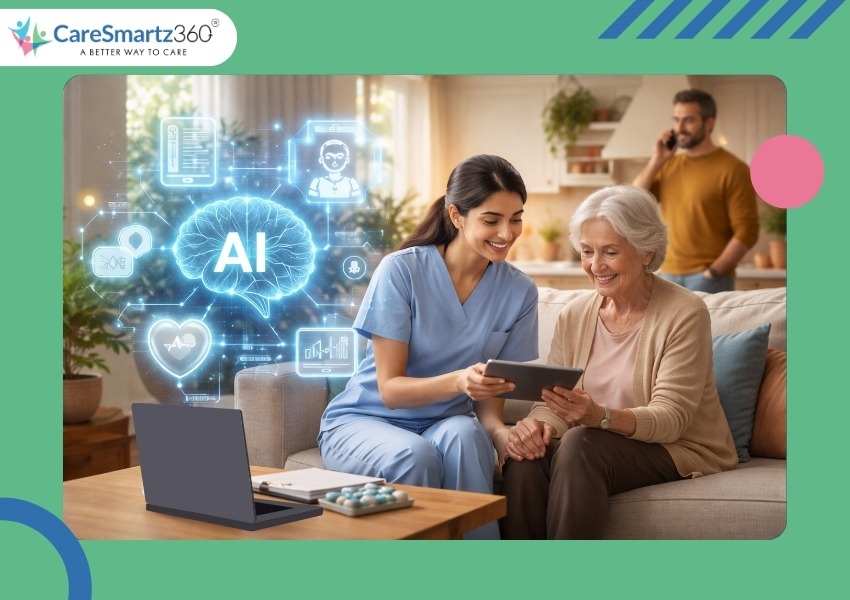
Agentic home care automation refers to agentic AI systems in home care technology that can independently monitor operations, make decisions & execute workflows such as scheduling adjustments, documentation validation, compliance monitoring, and billing preparation.
Unlike traditional automation that follows fixed rules, agentic AI in home care interprets goals and takes actions autonomously, turning home care software into an active operational partner.
Agentic AI systems can plan and execute tasks with minimal supervision, coordinating multiple agents in home care environments to accomplish complex operational goals.
For a long time, home care agencies have invested in home care technology to streamline operations. Scheduling platforms replaced spreadsheets. Electronic visit verification (EVV) replaced paper logs. Digital documentation replaced manual charts.
Still, most agencies face the same challenge of operational complexity behind the scenes.
Schedulers spend hours filling last-minute shifts. Billing teams chase documentation errors. Compliance managers monitor EVV records manually. Agency owners manage workforce shortages & reimbursement complexity. The industry digitized workflows but never truly automated them.
That is about to change. A new shift driven by agentic AI in healthcare and home care automation is redefining how agencies operate.
Industry analysts predict 40% of enterprise applications will embed AI agents by 2026, compared with less than 5% today. – Gartner
Software is evolving from a passive system into something far more powerful: a digital workforce.
Agentic automation is the next evolution of AI in home care and healthcare operations.
Traditional automation follows predefined instructions. Agentic systems work in a different manner.
Agentic systems can observe, reason, plan & execute tasks autonomously to achieve outcomes.
The system actively manages workflows without needing human guidance. In home care setup, agentic automation can:
These systems don’t just analyze data but act on it.
Demand for home health support is rising quickly due to aging populations & hospital-to-home care transitions. Meanwhile, agencies face mounting operational pressures :

Administrative workload is growing faster than agencies can scale teams.
This creates a fundamental bottleneck. And that bottleneck is operational—not clinical.
Agentic automation introduces the idea of a digital operations team working alongside your human staff. These AI agents monitor operational systems continuously and intervene when needed.
Consider a real-world scenario. A caregiver cancels a shift two hours before the visit. Traditionally, a scheduler must:

This process may take 20–30 minutes. With agentic AI in home care, the system completes it in seconds.
It identifies the best caregiver match, updates the schedule, sends notifications, and validates compliance. Human staff remain in control. But the system performs the heavy operational work.
Enterprise home care software has evolved in three stages. First came systems of record, which stored operational data. Then came systems of insight, which generated analytics and dashboards.
Agentic automation introduces the next phase: systems of action. These systems don’t just report problems. They solve them. This capability is particularly valuable in home care because operations are dynamic.
Schedules change hourly. Caregiver availability fluctuates. Authorization limits shift. Documentation errors threaten revenue cycles. Agentic AI continuously monitors these conditions and adjusts workflows automatically.
Many agencies underestimate how much revenue is lost only via small operational errors. Examples include: inadequate documentation delaying billing, authorization mismatches causing claim rejections & missed EVV validations creating compliance risks.
Across thousands of visits, these issues accumulate over time, and agentic automation prevents these problems before they escalate. The system keeps a constant watch on your operations in real time.
If documentation is missing, caregivers are prompted right away. If authorized hours are close to being exceeded, schedulers get a heads-up. If something looks off in billing, it’s flagged and corrected before a claim ever goes out.
Instead of reacting to problems after they happen, agencies can stay one step ahead, keeping operations smoother, cleaner, and far more in control.
Several forces are converging to make agentic automation viable today. AI systems can now plan, reason, and execute complex workflows with minimal supervision.
Modern home care platforms generate massive operational datasets—from EVV records to caregiver schedules and billing workflows. This data enables AI systems to make reliable decisions.
Home care agencies are under increasing pressure to reduce administrative workload while improving operational efficiency.
Automation is becoming operational infrastructure rather than a competitive advantage.
The future of home care technology is a hybrid workforce. A future operations team may include:

These digital workers will monitor operations continuously, execute workflows instantly, and prevent operational failures before they occur.
Agencies that adopt this model will scale faster and operate with greater resilience.
Technology in home care can be advanced, but its purpose is deeply human. At its core, home care is about relationships. Caregivers build trust with clients. Families depend on agencies during some of their most vulnerable moments. Coordinators juggle complex situations every single day.
But when administrative work starts piling up, those relationships begin to feel the strain.
That’s where agentic automation helps. It removes the operational burden, giving teams the time & clarity to focus on what truly matters: delivering exceptional care. It doesn’t replace the human element. It simply makes it stronger.
Every major shift in healthcare technology follows a pattern. Early adopters experiment first. Visionary agencies scale second. Over time, this shift doesn’t just impact individual agencies: it moves the entire home care industry forward.
Agentic automation is now entering that phase. And the agencies that embrace it early won’t just keep up, they’ll pull ahead. They’ll scale faster without adding chaos.
They’ll stay audit-ready, even as regulations grow more complex.
They’ll reduce the administrative burden on already stretched teams.
They’ll create a smoother, more reliable experience for caregivers.
And they’ll gain greater control and predictability over their revenue.
For agency owners who are planning the future, it is clear that 2026 will not only bring incremental innovation but mark the start of autonomous home care operations.
Download Blog

 AI Hub

