36:03 MINS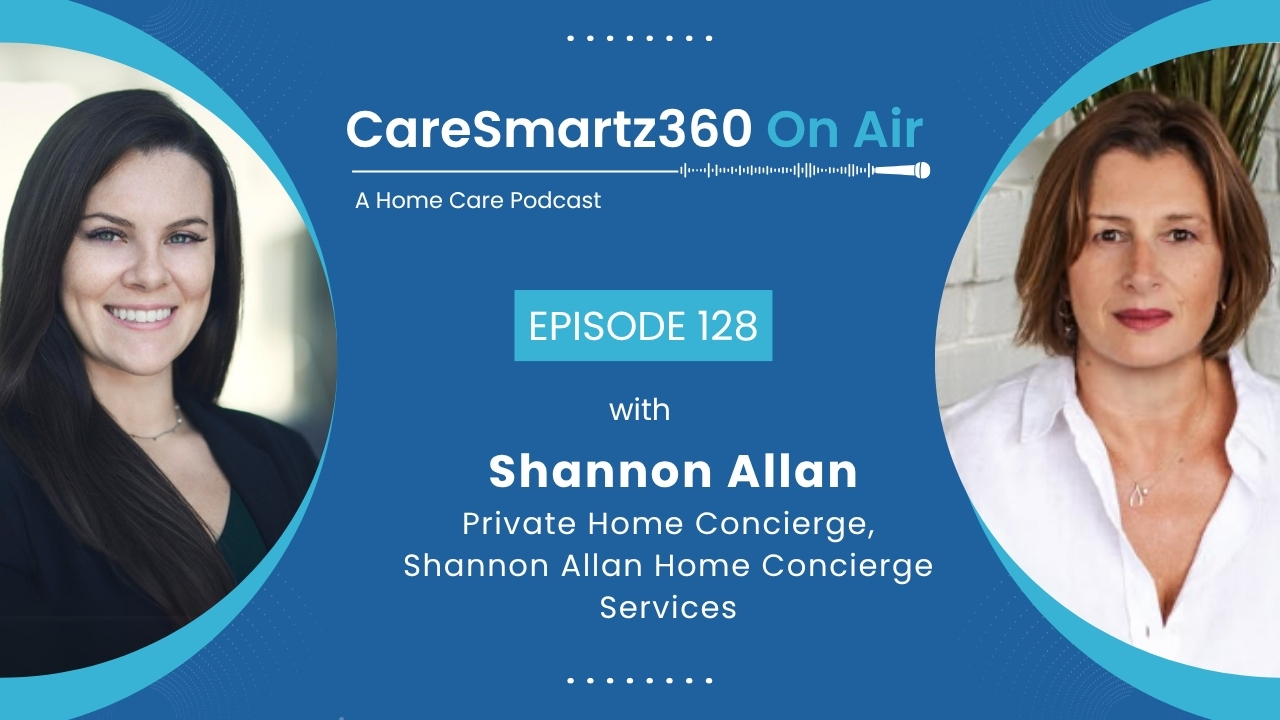
Join us as we welcome Shannon Allan, Founder of SA Home Concierge. After 25 years leading complex programs in fintech, software, and banking, helping her mother navigate Alzheimer’s inspired Shannon to build the practical support she wished her own family had.
In this episode, she uncovers the often-overlooked side of aging -at home, from everyday coordination to preserving independence and keeping older adults’ voices at the center of decisions. She also explores where home care fits in and how AI could help ease the load for families.
Trusted by 1,000+ Leading Home Care Agencies


00:00:09
Hello and welcome to CareSmartz360 on Air. I’m Erin Cahill at CareSmartz360. When an aging parent starts needing more support, the first instinct is often to take charge. Make the calls, schedule appointments, coordinate with family members, research good options, and solve problems as they arise. But in the process of managing everything, families can sometimes miss out on things their parents actually want. In this podcast, our guest discusses how care needs to be coordinated in a way that it
00:00:35
becomes an excellent personal experience. Shannon Allan herself has known that experience personally, and she is the Founder of SA Home Concierge – a personal concierge service supporting older adults and their families in Burlington and surrounding areas. Her work focuses on the practical, behind-the-scenes support which can help older adults remain independent while giving families some room to step out of the role of a full-time coordinator. Shannon came to this work through her own experience helping her
00:01:00
mother navigate Alzheimer’s and old age. After 25 years of leading large-scale programs across fintech, software, and banking, she found herself amidst a completely different type of complexity. One that did not have a clear process, defined responsibilities, or a system to rely on. This very own experience of hers led her to build the kind of support she wished once her own family had. In this episode of the CareSmartz360 podcast, we discuss what a
00:01:26
parent actually needs and what families need to be aware of. We also talk about the invisible work involved in helping older adults remain at home. And how families can support independence without taking over. Besides this, we also touch base on the emotional side of aging, the importance of keeping an older adult’s voice in decisions, and the vitality of better support for both families and those receiving care Welcome to the podcast, Shannon. >> Thank you. I’m excited to be here.
00:01:50
>> I’m passionate about this now. >> Absolutely. Well, we’re so excited to have you. And I’ll jump right into our first question here. Your experience with your mother shaped the way you do work today. What changed your perspective on supporting an aging parent? You know, I think I really didn’t understand going into this because my mother was a very bright, vibrant woman. Still is, just a little different. But, um, you just don’t know what to expect as these things happen. And I think a
00:02:21
lot of us see our parents as not really getting older, that they just are, you know, they’re going to live forever. And so, with my mom um she clearly um was having trouble and because of the type of dementia she has, she didn’t recognize it. It wasn’t um wasn’t like she was denying that she had a problem. She truly didn’t recognize it because it was affecting her brain. And so, we really struggled to help her for a really long time. And it took it took a point where she
00:03:01
actually, didn’t understand enough to um for us to really be able to help her. And you know, we ended up getting her to a doctor. Um but you know, the moment for me was like, we need help. We can’t continue to care for her. um was I had been living with her for a little bit just to see what was happening and she accidentally opened the fridge one night, took out a bottle of hot sauce thinking it was a bottle of orange soda and drank it back. And I thought, “Oh my gosh, how can we this?” Like I she’s
00:03:44
like a toddler now. I can’t leave her alone. So I work my I work in technology. I was 100% work from home. Um very busy career, my sister the same. And we knew we couldn’t take care of her at home ourselves. So um that was sort of the moment, and it was clear her needs were more significant and um we just couldn’t do it. I think had my mom been diagnosed earlier, I would have engaged sooner with um different care partners so that we could have kept her at home longer. But um you know we had our journey was a
00:04:28
little different in that um she had to really at the point in her disease it was better to make one move for her rather than move her into our home and then move her somewhere else. Um so that was our journey and that was very difficult. We didn’t know who to talk to when we first um knew there was something wrong. We tried calling our doctor. We did all these things. Um there was just no real clear way to get it done. And had I had someone to talk to pre prior to all
00:05:07
of this happening, um I think my sister and I would have felt a lot more capable of handling it. It was very scary for us because we knew there was something wrong. we couldn’t do anything about it >> of course >> because our she wouldn’t let us um yeah, so I mean that was that was the start of my like how thinking around how do people manage this because often you don’t know where to go I mean the Alzheimer’s society’s there but you’re like but maybe it’s not
00:05:39
Alzheimer’s or my parent needs care for themselves but you as a child you’re not sure like is this just normal aging? Like you I think we tend to rationalize things. Um and there just isn’t a lot of information. Actually, I shouldn’t say that. There’s a lot more out there now. I see a lot more of it. Um but it was very difficult. So when I decided to step away from my technology career and move into this, it was really because we didn’t know what to do. And as I learned more and more, I was like,
00:06:23
this is something that people really need. And especially with our lives the way they are now, a lot most most families I know have two working parents, complex lives, busy. if they’ve got kids, their kids are engaged in all kinds of things. So, you’re very busy as a family just managing your own stuff and then all of a sudden, you add in a parents needs or both your parents need support. Um, it’s almost impossible to manage. And so, that was my my, you know, the realization for me were, hey, I can help others. And it
00:07:03
was one of those things I was like, I spent 25 years in technology. It was great. I loved it. This gives me an opportunity to work directly with my clients, my pe my my families and really make a different on difference in their lives. So that was that was my I guess the impetus for me to start getting involved. >> Yeah, absolutely. And thank you for sharing that story. And why does the invisible work of managing life at home become such a burden for adult children? I think that invisible work it’s
00:07:43
not one big task. It’s where you know hundreds of little things. You know before my mom, we know before we had this incident with my mom early on you know we would get a phone call here. Oh I I I don’t know who to call. There’s something wrong with my sink or you know somebody called me and I don’t understand what they want. or you know simple things like can someone come over I can’t change the light bulb like there’s this it’s the tiny little things constantly where you
00:08:14
start to become their caretaker and I mean that sort of in the like their handyman their personal assistant all of those things so it’s those tiny little it’s like the tiny little cuts constantly um and it’s the hundreds of small decisions that you’re making around what to do. Do I go to mom’s tonight, or do I go to my child’s soccer game? It’s just it’s really exhausting and you’re trying, you know, you’ve got this you’re up in the middle of the night juggling
00:08:46
all the things. What am I going to do tomorrow? I’ve got all these things to do at work. Mom’s calling me. I remember a time when my mom called me at work and she had a question for me and I was like, “Mom, I’m I came out of a meet an important meeting for and it was something really small, but I assumed it was something really big.” So, it’s those the burden is that it’s not just one thing. It’s just it becomes constant and you’re the default contact, I guess, is really the is the message
00:09:15
there. And um because it’s not visible to anyone else, you know, you’re often times you’re not telling people about this stuff and your colleagues at work, your friends, they don’t know and it sort of becomes isolating and you’re exhausted. Um yeah, I just think that those are the things that you know you want to help your parent, you love your parent. I think most people when their parents call they jump and they think, you know, I’ve got to I’ve got to help out. There’s
00:09:50
something that my mom or dad needs. And so it just happens, you know, it just happens and then all of a sudden you’re running two households. You’re managing another life or another couple of lives. Um and we’re just busy. We’re busy this I think more than ever now technology we thought technology was going to make things faster and better and it has in a lot of ways but we actually spend a lot more time we’re just a lot busier >> so yeah so I think it’s
00:10:27
the burden’s really that that a couple of things let me try and summarize um it’s that you really become um an advocate for your parents . Um, you’re providing oversight, you’re providing guidance, and it’s those hundreds of decisions that you’re making on top of your own, you know, for yourself and your family that that really becomes exhausting, worrying about did they get to their appointment on time or um I wonder if you know, mom remembered that someone was coming over to look at her
00:11:08
sink that she called me about the every day, you know. >> So, >> yeah. >> Does that make sense? I >> Absolutely. Yeah. It’s all those decisions that add up and that uh that mental energy on top of all the things you have to do. Yeah. >> Yes. Very much that summarized very well. >> And Shannon, how can families make an adult feel worthy of their decisions without making them feel like they don’t have a say in their lives? >> I mean, that’s a huge issue. And I
00:11:37
think as I my a lot of my clients are the adult daughters of parents, right? And I think and often, you know, the oldest daughters and I think we tend to be very focused on getting things done and we’re doing things for all the right reasons. And I know for me I’m very can be very driven and laser focused on things and sometimes you forget, you know, that you’re you doing what you’re doing is for your parents and you’re doing it in their best interest. You have to remember they
00:12:18
they’re you know grown adults with ideas and desires and wishes. Um, and we sometimes forget that. So, it’s really about dignity. >> Um, less about control, but more about dignity. Um, so it’s really about including your older adult, your parent, um, your loved one in the conversation. Even like with my mom where she’s, you know, we now have POA for her decisions, we still involve her in the conversation. She still has an opportunity to say something. um to share her wishes. Um and you know,
00:12:59
obviously, we want to make sure we’re adhering to those as best we can. Um, I think having a giving them the opportunity even maybe it’s in those small decisions like when you’re if you’re if you’ve got someone who is cognitively impaired like my mom, maybe we’re not she’s not making the decision that day about whether she’s going to go visit someone because there’s no one there to take her. but she can make a decision about whether she um you know what she has for a snack. Is
00:13:38
she going to have an apple or is she going to have cheese? >> And that I mean that’s very similar to you know with Alzheimer’s sometimes I I liken it to a toddler where it’s you’re giving them those types of options. If it’s if it’s just an older adult who is starting to struggle more with what they’re doing at home, it might be, you know, um you’re So, for me, as an example, I would go into a home and I’ve done this with a client where we’re talking about things
00:14:11
to support that person to live in their home. Um they want to have someone come in and do their landscaping. I will bring them a short list and then they all meet with those people and the older adult, the their child and myself will sit down and talk about it and that older adult speaks to what they liked about the different people that they met. We may they may not end up with that person be because there’ll be a conversation about, you know, pluses and minuses on both sides. Um, but they’re heard and
00:14:48
I find just being part of that conversation makes it much easier if the choice ends up being something different than what they had initially anticipated. Um, so I really do think it’s about dignity in daily moments, choices within a choice, um, and involving your parents in the conversation or your loved one in the conversation. um regardless of you know whether they are ultimately going to make the decision or not um it’s all in how we approach the conversations. I think that’s one thing that I really learned
00:15:34
um with my mom was sometimes um you know you go in guns a blazing even though you don’t intend to um and so it’s really yeah it’s really about >> I’ve said this even when I was in technology and I was managing large teams and things you have to treat people the way you want to be treated and it’s really it’s really about that right >> how would do want someone to behave with you when uh they were helping you, supporting you through this stage of your life. And so choices and
00:16:13
dignity are are key. >> Yeah. And I think what you said about being heard is such a key part of all of that. >> Yeah. Yeah. >> I guess I think when I think about dignity, the Yeah. The being heard part is probably the biggest part. And you know, I’ve seen it on both sides with, you know, an aging parent who’s just aging and starting to need more help versus my mom with um, you know, a cognitive decline. with a cognitive decline. Even in conversations, sometimes if you’re
00:16:47
not engaging with my mom, if you’re talking to someone else, that becomes very um aggravating to her because she’s not part of the conversation. So, it’s almost like in um with cognitive decline, it’s heightened heightens everything. Mh. >> So, you know, a parent can control themselves a little bit better if they’re just a parent, not just a parent. If they’re a parent whose children are helping them a little bit more um they can control themselves in that conversation a little
00:17:17
bit more, they will wait and be patient. But with um someone who’s cognitively in decline, they start to lose their that that control, right? And so it’s really interesting for me to to to see how those um conversations go. Um but definitely families that listen to their um listen to the older adult, the person needing the support. It goes a long way. It really it really makes things easier for everybody. And I think you have a happier person at the end of the day, right?
00:17:57
what they want. Yeah, >> absolutely. And Shannon, what role can home care play in taking pressure off families while keeping the older adult at the center? So, I mean, home care is phenomenal. I think for families um it allows the older adult like the child the child to kind of get back into being the so the daughter or the son. Um so really maintaining that family experience so you aren’t everything. You’re not what I talked about before about being sort of the caretaker, you know, the every
00:18:39
everything. So that falls away. Um, and it allows you as the as the child to still participate as a family member instead of like every Sunday dinner going and you know um completing a task that needs done doing. Um I think you know it lifts that burden. it it what people say to me about the work I do is they can finally relax because they know there’s somebody there who’s holding all this stuff who’s and so when you talk about um bringing in care you know if you talk about PSWs or maybe someone
00:19:21
even you know someone to come in to cut their hair someone to come in to as um just uh for companionship all of those things it means you’ve got eyes on that It gives the family a lot more comfort that there’s um that their parent is being supported. Um I think there’s an operational side that the families don’t see but they absolutely feel. So, um, if somebody doesn’t show up, if there’s a miscommunication with those kinds of things, if they, um, start having, you know, a revolving door of
00:20:00
caregivers, people that they don’t recognize, that becomes problematic. Um, so I think the places that get it right and the groups that are really doing the best work are investing in both the infrastructure behind the care, but also um, you know, I think that’s the behind the-scene things that people don’t put enough um, emphasis on, people don’t really think about as much. obviously the caregivers themselves. So the companies that are focused on having you know wonderful caregivers
00:20:39
um consistency of care those kinds of things are and I guess those that that’s the operational side the consistency of care but those are the things that are really going to make the difference um for families is feeling the relief of having those care providers there knowing that those care providers are going to be on time are likely going to be the same handful of people every time. Those are the things that really make the difference for the family. Um both the both the person receiving
00:21:12
the care and the and the ones who are worrying about whether or not they’re getting the care. >> Absolutely. And how could AI help families and home care providers manage the practical side of aging at home? So that’s a like a super interesting question because I hadn’t until you know I hadn’t really thought about AI um but I think on the family side AI can reduce like administrative and monitoring burden um reminders coordination of things um even flagging changes >> um in their in their loved one. But I
00:21:50
think on the provider side, there’s so much more that people can be doing. Um, you know, like I said earlier about um, you know, monitor, who’s going where, um, um, what’s the right I’m losing my language here. Give me one second. >> Yeah. >> Um, I’ve totally lost the word. Give me one second. >> Yeah. Yes. We may have all the time in the world. >> Oh, okay. >> You’re doing great. >> Oh, I feel I feel like I’m rambling a
00:22:31
little bit, but I have a >> really good conversation. I think a lot of people tap into it, right? Um >> I think that’s I think my superpower is that is just that I >> Yeah, >> I am that. >> Yeah, absolutely. I’m seeing I’m staying with a friend here right now and their family is going through the exact same thing. Oh, good. Well, we should talk. Um so let me just compose myself again and think about this question. So >> um >> the practical side of aging at home. So
00:23:01
>> So the question was how could AI help families and home care providers manage the practical side of aging at home? Okay. So I think a you know AI provides is now going to be able to provide us with some unique things that we never had before. And with my background in technology, you know, for 25 plus years, I I saw the evolution of technology. Um and you know I’ve always said technology can take us only so far. I said that working in technology I spent 20-some-odd years d you know leading large quality
00:23:55
assurance organizations and you know I saw automation come in um and a lot of senior leaders were like oh we don’t need testers anymore we can just we can just automate everything and I still believe and I know there’s lots of automation that still happens but I still believe that you can’t completely remove the human touch and the human intuition and the things that a a machine just can’t see or feel. And I feel the same way about AI. I think AI can provide all kinds of supports both
00:24:33
for families and caregivers. Um but you know, particularly in this kind of work, trust and relationships are key. So that all being said, I think there’s great value in AI for the families in again in reducing administration um you know setting having reminders um some level of coordination um there there’s definitely an opportunity for AI to support people like me and my clients um in managing their loved ones life because that’s they are doing that at this point. But on the provider side, I
00:25:22
think there’s so much opportunity and I think I mentioned it a little bit earlier around um you know staffing, coordination of staff, scheduling um even analytics like being able to quickly take the data that is being fed in through um whatever systems you’re using. um you know, you might be able to tell just based on a couple months of data from your caregivers things that you’re seeing come up across multiple clients that are similar. They might not be the same, but then you can address. So I
00:26:08
think like from a purely operational point of view, I think there’s so much opportunity with AI. Um and I as I said before, I think the organizations that are leveraging the strong operational side with the care side are the ones that are going to be most successful. The one other thing I would say about AI too is um well, you know what maybe I guess I’m thinking about as we see boomers getting older um and more and more seniors in our population. Um being able to scale is going to be
00:26:55
really important for those care providers, I think. And so, AI has got to have some role to play in that. >> For sure. Yeah. And my last question for you, Shannon, is what do you think the next generation of home care will need to get right as more people choose to age at home? So again, I think it’s, so I think I don’t think I know my business is built on relationships and trust, and I think that is going to be key. I think you know that home care it isn’t great now at least in the
00:27:41
communities that I serve. the continuity and I shouldn’t say that that sounds like the care isn’t great. The care is wonderful and the people providing the care are generally wonderful. I think though that we aren’t great at that continuity of relationship. I think that a lot of people who are currently aging at home need more support. A lot of them get just constant change in who is coming to support them. And I even see it in care homes. I’m really lucky in the one my mother’s in, there has been very little
00:28:19
turnover in their PSWs um or their nursing staff, but in a lot of them that I see that I have clients in, there is a lot more inconsistency of care. There’re different people in and out. And again, I I’m highly sensitive to Alzheimer’s and dementia pieces. um that’s really jarring for, you know, people in cognitive decline. And I think when you’re an older adult, um who needs care, you feel much more vulnerable. And so, you know, you don’t know um if you don’t know someone who’s coming in to
00:29:00
help you and maybe they’re showering you, that’s really uncomfortable. I I know my mother-in-law had some surgery and needed some support, and somebody showed up who she wasn’t expecting and she turned them away. So if you know and I’ve heard that from other uh clients where someone comes to the door and they turn them away because they don’t feel comfortable. So anyway, um I think that continuity of relationships is key really going to be key. I think um
00:29:33
another piece that um I try to bridge the gap within my business is I have some clients who live out of country and their parents are here and so communication is really key and that means being able to communicate the with the family without overwhelming them. um having some real-time visibility I think from the agency side like from the the caregiver side where people are able to share what’s going on. Um and I think that that gives whether you live close or you live far away, you’re not with your parent 24
00:30:20
hours a day. And so having better communication um like I say that doesn’t overwhelm but that gives um families that comfort and the information that they crave and really need to make good decisions for their parents to help their parents make good decisions. That’s going to be critical. Um we talked about dignity and choice in those daily moments. So, I think that will continue to be uh really important. And I don’t think that ever changes. Um, making sure that the person receiving the care is heard.
00:30:59
Um, I think and I, you know, I think that’s something that I’m seeing evolving more and more in care homes. You aren’t seeing people being asked to do something, and when they say no, saying no, well, you’re going to do it. But it’s almost even in even without um cognitive decline, it’s about, you know, I’ve seen caregivers ask somebody say, you know, let let’s go and let’s go to the exercise room and join the exercise class. And someone will say,
00:31:32
no, I don’t want to. So instead of saying, yeah, yeah, we’re going to do it. I’ve seen people say okay and then they go away for five minutes and they come back and then maybe that at that point someone wants to move that or they give them another choice and so it’s I had a grandmother who was in care in the 80s and it was a very different situation then there wasn’t a lot of choice it was more like we know best and you’re going to do what we want you to >> so I think that again that dignity and
00:32:04
and listening to what people say is really important Um I mentioned I think earlier um scaling for agencies is going to be massive I think because there is such a need for there’s you know for home care support I know um here in in our region it’s nearly impossible to get um an occupational therapist in a timely manner like sometimes by the time you get the occupational therapist whatever you needed them for is no longer an issue. you um and so being able to scale and but also scaling and not losing that
00:32:45
personal touch. So that is going to be a unique challenge. I think I don’t know how you do that. I know you have to do that by maintaining humans involved not just in the care giving but also on the operational side the you know people being able to analyze the data not just taking the data and saying oh it says to do this but really looking at it and again this is something I’ve said both through my career in technology when my kids were in daycare and now with a parent in home care in in
00:33:24
a home um and looking at the home care um providers listening to the people who are interacting day to day with the clients they are the ones who can tell you what’s really going on because I think sometimes you know when you think about operations and operating a large company that might be you know might have hundreds of caregivers You sometimes you probably started down there. You probably started with your hands in everything, but you get into these roles, and you think you know and you don’t.
00:34:05
Things change. Um the issues that caregivers start to see change. um and taking analytics that you know come through based just purely on data without the story behind them. That’s where we’ll go wrong. So I think that it’s really critical to um you know if I were running a largescale organization that was providing caregivers, I would never stop talking to the people who are actually doing the work and if at all possible, I’d be talking to the people receiving that care. I think that’s critical and
00:34:49
really listening to it. Um cuz it’s easy to sort of say, “Oh, it’s the grumpy people that fill out the surveys or the ones that call are the ones like people who are happy never do.” I’ll tell you, the people that are happy, they also will tell you that they’re happy. So, you have to listen to those that are complaining as well because they’re probably seeing reality. Um I think that’s it. I think Oh. Uh, yeah. I think that’s it. It’s really
00:35:24
that tension between staying close and um and growth, right? How do you do that? Those are going to be big things. >> Absolutely. And it’s a home care challenge for every agency moving forward. Um, but thank you so much, Shannon. We really appreciate having you here. Um, I know a lot of people are experiencing this in their life and will experience this. So, um, you’re a lot of actionable insights. We really appreciate it. And everybody listening at home, this has been CareSmartz360
00:35:53
on Air and we will see you next time. >> Thanks. >> Thank you so much.
Listen to the episodes on loop for a premium CareSmartz360 on Air experience
 AI Hub