19:24 MINS
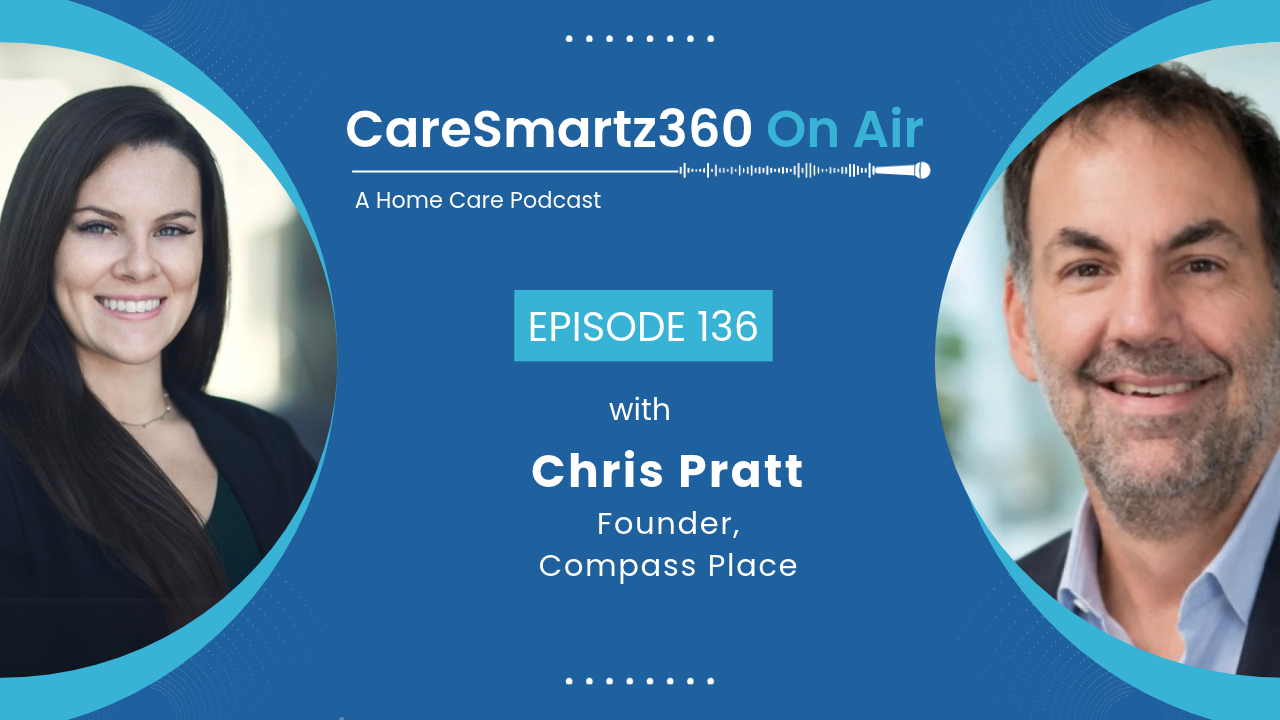
Join us as we welcome Chris Pratt, Founder of Compass Place, for a conversation on one of the biggest challenges in non-medical home care: balancing client acquisition with caregiver recruitment and retention. With a business-focused perspective on home care growth, Chris brings valuable insights into managing caregiver capacity, meeting client demand, and building a sustainable home care agency.
In this episode, Chris explores the challenges home care agencies face when growing their client base while maintaining adequate caregiver staffing. From deciding when to prioritize hiring over client acquisition to recognizing the early warning signs of unbalanced growth, he discusses how agencies can avoid overstretching their resources. He also shares his perspective on how scheduling, operational visibility, and technology can support smarter growth decisions, along with the potential role of AI and what agency owners should prepare for heading into 2027.
Trusted by 1,000+ Leading Home Care Agencies


00:00:09
Hello and welcome to CareSmartz360 On Air. I’m Erin Cahill at CareSmartz360. Join us as we welcome Chris Pratt, Founder of Compass Place. Chris brings a business-focused perspective on non-medical home care, including one of the industry’s biggest growth challenges: balancing the need to bring in new clients the need to recruit and retain enough caregivers to serve them. In this episode, we’ll explore how agencies can balance client demand with caregiver capacity, make smarter
00:00:36
growth decisions and build a business that can scale without stretching its resources too thin. We’ll also discuss how AI could shape home care operations and what agency owners should prepare for as we look toward 2027. Welcome to the podcast, Chris. >> Erin, thank you for having me. I’m super excited for the conversation. And I think it’s a great topic and hopefully lots of people are interested because it is certainly a challenge in the home care space. >> Absolutely. So, we will jump right in.
00:01:04
Chris, my first question for you. Why is balancing client acquisition and caregiver recruitment so challenging? >> Well, the biggest challenge I think you have is that you’re trying to synchronize two entirely different unpredictable markets. You know, a home care agency has very little control over when a family needs care or how many hours they are going to need or how long they’ll remain a client. You know that that can be a big difference between your, you know, a private pay client
00:01:36
generally, uh last stays a little shorter than a Medicaid client. So, when you’re thinking about your client mix, um you know, you need to be thinking about all these variables. So little control over the needs of families. And then the other side of that unpredictable market and maybe it’s more predictable but it’s not I wouldn’t call it predictable and that is you know you have limited control as an agency owner over caregiver availability how many hours they want to week uh to work per week
00:02:08
when they want where they want and then ultimately what sort of skills they have that that can or cannot sometimes align with the needs of the clients. So just because you have you may have 200 hours of caregiver capacity, you may still be unable to staff a 20our client because they’re the wrong place or the wrong time or don’t have the right skill set. So for my mind, home care isn’t really just a supply and demand business. It’s more about a matching business. And that matching, fortunately
00:02:42
or not, has to happen every single week, >> right? Yeah. No, that makes sense. And we see that all the time with the homecare agencies that we work with. And Chris, how can owners know whether to prioritize hiring or client acquisition? Well, the trick I think is to measure usable capacity. It’s not simply a matter of headcounts or how many inquiries you have. Um, you know, it’s within these variables of the of the where, the what, and when that an agency owner has to be thinking about
00:03:18
their caregiver capacity. So, how many additional care hours could we reliably deliver next week and how are they broken down by geography and schedule and care need? And then how many qualified client uh demand do we have for those specific hours? So if caregivers are underutilized uh you know then obviously that means that you know client acquisition needs to be where your focus turns. However, if overtime is climbing or suitable caregivers or scarce recruiting and retention deserves a priority. So
00:03:56
obviously, that’s a fundamental skill that a home care agency owner has to have. But the way I like to look at it is things that are difficult to do and things that are difficult to master, those can often be opportunities for I always encourage my teams to embrace those uh those challenges. If you embrace something as a challenge and you really take ownership of becoming excellent at things that are hard, then that’s an opportunity to differentiate yourself from your clients and all from your
00:04:29
competition, excuse me. and then ultimately, you know, create a more uh more robust business. So, yes, it’s hard, but hard things also allow us as the home care agency owners who are going to try uh to be able to stand out and excel. So, before you decide whether to hire another caregiver or whether to find another client, uh just make sure that you’re not overlooking that capacity that you may already have on your team, >> right? Absolutely. And how can agencies grow without overwhelming caregivers?
00:05:06
>> Um, I think that the trick is that you need to focus on selective growth. So, not every single new client represents an equally attractive growth opportunity. I I think back to my prior life. I was in construction and there was a very large convenience store chain that I’m sure everybody listens to knows and uh you know they came to us with a big project. We had an opportunity to bid on it and we probably could have won that project, but I just knew deep down that
00:05:41
as a company we were only a few years old. We really weren’t in a position to be able to capitalize on that. And I ultimately just had to make the decision I’d like to think of it as the mature discipline decision to say, “uh you know not now you know we can’t help you with this project. And so, what I did from that moment I remember hanging up the phone and being upset because I wanted that new great big project and I wanted to be able to put that logo on our website. I wanted all those things that come with,
00:06:15
you know, landing a great big account is different than home care, but the same concept. And I just knew we weren’t. So, when I hung up, I set out to start building the infrastructure and the team that I knew would need to be able to handle a project like that. So, that was upgrading talent. uh it was investing in equipment. It was investing in different skill sets that we hadn’t really, um you know had in-house at that time. So, all those things put us in a position and I’m
00:06:48
happy to report that it was about a year and a half later they came back and they said hey we have a uh we have another project was bigger than the first project and at that point we were ready. Now if you’re asking was I still nervous that you know that did I know we were ready? No. But I was a lot further much more confident and a lot further along, you know, in my mind in terms of where we were as a company and able to handle that new growth. So how that translates to home care in my mind
00:07:19
is, you know, a client who might need four hours on a Saturday evening, but they’re 35 miles away from your nearest caregiver. You have I think you have to be disciplined to say maybe that’s not our best uh fit that not our best opportunity to grow. So how that translates into some real world, or you know when you’re in the trenches the day today, I think you need to be thinking about building geographic density rather than just accepting you know any client that you can find. And I
00:07:51
know that’s super tempting especially as a new business but really any business under pressure to grow. You know, there are uh there are of course uh national aggregator websites where you can buy leads and I’ve seen too many homecare agency owners go, “Oh, we’ll take them anywhere, anywhere in the state or anywhere within two hours or whatever.” And that’s a tough way. That’ll work for a while, but ultimately that’ll lead to challenges. Uh being
00:08:20
Transparent is another, you know, data sort of day-to-day task. be transparent with families about when you can realistically begin your services. That’s also uh an indicator you’re having trouble with that. We’ll you know, I think we’ll probably cover that more, but that’s telling you something. If you can’t jump on a new opportunity quickly, that’s telling you something about where you are an operation and if you can continue to grow. So, a
00:08:48
new client isn’t necessarily good growth if it means that that client is going to exhaust your existing caretakers, caregivers who uh who serve your existing families, >> right? Yeah, that makes sense. You must build that foundation to be ready for that growth. So, Chris, what are the early warning signs of unbalanced growth? Uh Erin, I like this question a lot. Primarily because it makes business owners think about their business through maybe a different lens than you might. It’s so easy to get pulled into
00:09:25
the whirlwind of caregiver scheduling and recruiting and all the work. But you really do need to be monic, you know, observing and managing your business from a higher altitude than always being in the whirlwind. And so, when you’re thinking about early warning signs, you think about lagging indicators versus leading indicators. And what you want to pay attention to are leading indicators. And what we have a human nature tendency to pay attention to is that l is lagging indicators. So, to give you a few examples of that, a
00:10:02
lagging indicator would be a client that complains about something that happens as a result something that did or in this case didn’t go well. A leading indicator is that you’re starting to have more unfilled shifts and you’re having your admin team cover, or you’re asking some of your caregivers to cover a second shift that they weren’t planning on doing. So those are the leading indicators. A lagging indicator might be caregiver turnover. That’s certainly a huge challenge in the
00:10:31
industry. It’s also a lagging indicator, which means it’s not the thing that you need to be managing. The thing that happens is because you struggled to manage something prior to that. So again, increasing overtime or asking your caregivers to travel far distances and it maybe not be enough compensation, that’s more of a leading indicator. Lost clients would be a lagging indicator. Um whereas a longer start uh before you can start care, a little more of a leading indicator.
00:11:02
Negative reviews uh are lagging indicators. declining margins are lagging indicators. So, all those things as humans and even as business owners in the whirlwind we have a tendency to focus on those things but it’s the things that cause those things which is really our opportunity to better manage those issues you know really as a business owner. So, one of the really one of the best ways especially for smaller agencies uh in terms of a lagging indicator is how often the owner personally has to come in and rescue the
00:11:40
schedule. If that’s happening all the time where the owner has to cover shifts or the owner has to just get involved and casual and convince your caregiver to work the extra shift or ask the admin an admin person to go cover. If the owner is personally rescuing the schedule, that’s a lagging indicator that you have you have something upstream that that needs your attention. So, if your business only works because the owner is constantly rescuing it, that’s not a scalable operating model,
00:12:15
>> right? Yeah, of course. And Chris, what happens when an agency accepts more clients than it can support? >> Well, it’s a cascade or a domino effect. uh you know you have too many clients that you’ve committed to. So, you start asking your caregivers to work overtime or work on additional schedules. Uh that leads to frustration and if frustration grows enough, that leads to turnover which leads to inconsistent client experiences and all the challenges that we’ve described. uh which ultimately to
00:12:52
you know damaging your reputation as an agency, bad reviews, referral partners starting to think maybe I don’t think I can recommend that agency anymore. They’ve really struggled with the last few clients that I’ve recommended. So, all those things have a cascade effect in or a domino. I’m not sure which the better analogy is, but it I think we need to remember that when someone is arranging for home care for an aging parent or a loved one, they’re making that
00:13:25
decision um under typically, you know, a lot of emotional pressure. And quite frankly, that was one of the things that appeals to me um senior care um and senior living in General and Senior Care is being able to be involved in more meaningful things. I mean, when I was doing that construct myself when I ran my construction company, did I want all the projects to go great? Of course I did. is that I want our direct internal clients at our CL, you know, at our at our customers to have good experiences
00:13:59
and to be able to report to their bosses that the project got done on time or it got done on budget. Yes, I wanted all those things and it was important, but at the end of the day, it didn’t really matter if a project got done on Tuesday or a project gets done on Thursday. Well, senior care is not exactly like that. it, you know, these things can’t um can’t slip. Um and so it’s more important um the ultimate outcome is impacting people’s lives and hopefully that’s in a good way. I
00:14:33
know we’re all striving and aspiring for that to be a good positive experience for families. Unfortunately, it doesn’t always work that way in the real world comes in. Um, so family members, they certainly can feel less stress from when they get a caregiver and an agency in place, but it also it doesn’t mean that they don’t feel any stress at that point. And ultimately, it’s a matter of building trust over time that okay; this agency has stepped up. They’ve got a
00:15:08
solid caregiver or caregivers in place, but it’s slow, it’s a slow trust building. So, you know, in home care, it’s not just that you’re selling hours. You’re making a promise to the family that someone will be there. And that’s an important promise. >> Very much so. And what role can schedule, operational visibility, and technology play in this? >> Well, I think it’s a fascinating question. Um it has been um I think we’re in the beginning of what is
00:15:40
already proving to be a wild ride with watching how technology is evolving and there are so many great companies out there offering new solutions um you know utilizing AI in some cases just to build the products and in some cases using AI to make the products. Um, you know, I think that technology, you know, in the near term, can help agency owners better manage that capacity and demand. We talked earlier about the two different pipelines and how those pipelines need to be, you know, really dissected into the into the
00:16:18
where, the when, and the what. And so, technology can help manage that. It can identify scheduling gaps. It can match the caregivers more efficiently. And ultimately back to the leading and lagging indicators, it can stop developing problems really more before they come to become emergencies. So, I think the best technologies that are out there will help the owner you know make three decisions more confident. The one would be, can we reliably serve this new client? um which amongst my existing caregivers are the best fit and
00:16:56
then where should we focus our energies more on recruiting or more on client acquisition. And at today that is a week by-week if not day by day type of decision-making. But um but as the tools evolve and as technology grows um you know it’s probably not going to be able to create caregiver capacity at least not until we have, we have robots in the home which you know hey that might be that might be sooner than we think but the technology can today help us understand the capacity that that you
00:17:32
have within your agency and use it more intelligently. >> Certainly. And Chris, my last question for you is looking ahead to 2027, how might running a non-medical homecare agency change and what should owners do to stay ahead and prepare for that? >> I think it’s important in any business that you stay connected with emerging trends. you take the time to consider the tools that are evolving in the industry. There are tons of software platforms. There are there are um so many companies out there
00:18:14
bringing products uh you know age tech products into the market designed to help home care agencies uh and designed to help you know any other senior care or living senior living but take the time to explore those whether that’s trade shows whether that’s attending webinars whether that’s watching podcasts like this one take the time out of your day if you if you if you keep your head in the sand or, you know, buried and only focused on the day-to-day, you’re quickly going to be passed by
00:18:47
agency owners who have been disciplined enough to keep their eye out above the landscape and not just totally focused on the work right in front of them. >> For sure. Well, Chris, I really appreciate your time. I think you have a lot of insights here that all our home care agency owners can certainly work with and um some actionable insights. So, thank you so much for your time and for all our listeners. Thank you for tuning in to CareSmartz360 On Air. We will see you next time.
Listen to the episodes on loop for a premium CareSmartz360 on Air experience
 AI Hub