Sustainable growth in home care franchising is rarely accidental – it’s built with intent, discipline, and a deep understanding of what truly drives long-term success. While many franchise owners enter the market with strong demand on their side, not all are able to translate early traction into consistent, scalable growth.
The difference often lies beneath the surface. High-performing franchises do more than fill shifts and manage day-to-day operations – they invest early in systems, standardize critical workflows, and build teams that can operate independently without constant oversight.
At the same time, they stay closely connected to their communities, nurturing referral relationships and earning trust that fuels steady client inflow. As the industry evolves – with tighter regulations, workforce challenges, and rising expectations – growth is no longer just about expansion; it’s about resilience.
The franchises that succeed are those that balance operational excellence with human connection, using structure to scale while staying rooted in purpose. Understanding how these agencies build sustainable growth offers valuable lessons for any home care leader looking to move beyond survival and create a business that thrives year after year.
To shed some light on the same, we interviewed a home care industry expert to bring her perspective on how home care franchises build sustainable growth.
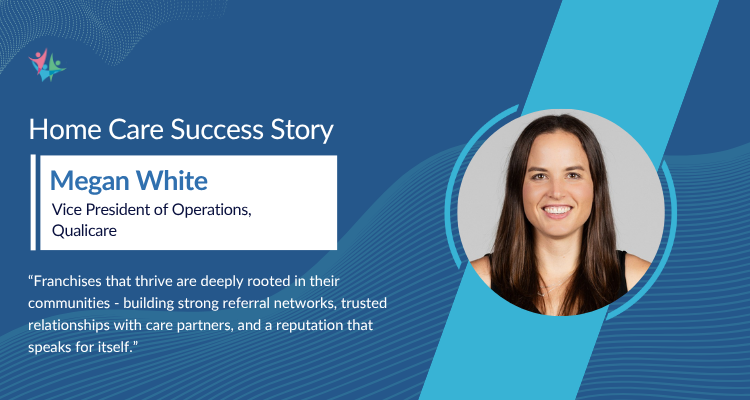
Who Did We Interview?
Megan White leads growth and operational strategy across a rapidly expanding franchise network. With over a decade of entrepreneurial experience, she specializes in scaling businesses through strong systems, people, and performance.
Megan works closely with franchise owners to optimize operations, drive profitability, and build sustainable growth, combining strategic leadership with hands-on coaching to help teams thrive in today’s evolving home care landscape.
Let us now delve into what she has to say about how home care franchises build sustainable growth:
The franchisees who scale successfully treat their business like a business, not a job they own. That sounds simple, but it’s a meaningful distinction. The ones who struggle tend to stay in the weeds: doing the scheduling, covering shifts, managing every caregiver relationship personally. They’re so busy working in the business that they never get the chance to work on it.
What separates the high performers is that they:
Being part of a franchise network is one of the most underutilized advantages in franchising. You don’t have to figure everything out on your own. There are people in your network who have already been where you are, made the mistakes you don’t have to make, and found what works.
The franchisees who lean into that, who actively seek out peer learning, ask questions, and apply what others have already proven tend to accelerate their growth significantly.
The areas where inconsistency creates challenges are intake, scheduling, and caregiver onboarding. These three functions happen constantly, and when there isn’t a consistent process followed by everyone involved in that function, quality of care can suffer, and so can both client and caregiver retention.
Intake in particular is underestimated. How a call is handled, how quickly a family gets a response, and how clearly expectations are set in the first conversation directly impacts whether that client converts and stays. When you standardize the inquiry call process (with actual language, objection responses, and a clear next step), you start to see conversion rates improve across the board.
Scheduling is where a lot of the day-to-day stress in a home care agency lives, and inconsistency here has a direct impact on both clients and caregivers. When scheduling decisions are made reactively (filling shifts at the last minute, prioritizing availability over compatibility, or relying on one person’s institutional knowledge), you end up with higher caregiver turnover, more call-outs, and clients who don’t have the continuity they need.
Standardizing how schedules are built, how changes are communicated, and how conflicts are resolved creates a more stable experience for everyone involved.
Caregiver onboarding is the other critical one. High turnover is endemic in home care, and a lot of it is preventable. When caregivers feel well-prepared, well-supported, and connected to the mission from day one, retention improves. That doesn’t happen by accident but through a repeatable onboarding process.
Growth exposes whatever wasn’t built properly for the first time. The most common breaking points I see are communication, staffing ratios, financial awareness, and leadership.
Communication tends to fracture first. When a franchisee goes from managing five clients to fifty, the informal systems they relied on (mental notes, quick texts, knowing everyone by name) stop working. If they haven’t built a real communication infrastructure, things fall through the cracks.
Clients don’t get follow-up. Caregivers don’t get feedback. And owners don’t have visibility into what’s actually happening. Staffing is the second pressure point. Growing your client base without a parallel plan to recruit and retain caregivers is one of the fastest ways to damage your reputation in a market. Home care is a relationship business, and continuity of care matters enormously to families.
Then there’s financial literacy. A lot of franchise owners can tell you what their revenue is, but not their gross margin by service type, or their cost per hire, or what their ROI is on specific marketing initiatives. Without that level of financial awareness, an owner may not see the growth on the bottom line as much as they see growth on the top line.
And finally, leadership. As the business grows, so does your full-time team, and the ability to lead that team effectively becomes one of the most important skills an owner can develop. This means setting clear KPIs, building a culture of trust and accountability, and holding people to what they’re responsible for achieving within the business, all while ensuring they have the training and knowledge to actually do it.
Many franchisees are strong operators early on, but scaling requires a genuine shift into leadership. The owners who invest in developing that muscle tend to build far more resilient businesses.
This is one of the most nuanced tensions in franchise operations. The way I think about it: autonomy should be earned and expanded over time. A new franchisee needs guardrails, not because they lack intelligence, but because the system exists for a reason, and the learning curve in home care is steep.
As a franchisee demonstrates competency in core areas, they earn more latitude to adapt to their local market. Where I hold the line is anything that touches client safety, care quality, and brand reputation. Those are non-negotiable, and they need to be framed that way from the beginning. They are the foundation of what makes the brand worth buying into.
Beyond that, I genuinely want franchisees pushing back and bringing local knowledge to the table. In franchising, the majority of the best ideas often come from franchisees themselves because they’re the ones experiencing the day-to-day reality of running the business and are closest to the clients.
They see what’s working, what isn’t, and where the gaps are in ways that the home office simply can’t from a distance. The best franchise systems create a real channel for that kind of input, because the relationship should never be purely top-down.
Adaptability and depth of relationships will define successful home care franchises in 2026. Externally, the franchises that thrive will be the ones who are genuinely embedded in their communities. That means consistent presence with referral sources, trusted relationships with hospital discharge teams and senior living facilities, and a reputation that precedes them.
Referral-based growth is still the most sustainable pipeline in home care, and it takes time and consistency to build. Internally, the defining factor will be caregiver culture. The labor market for caregivers isn’t getting easier, and the agencies that treat caregivers as a strategic asset (investing in their development, recognizing their contributions, and creating a real sense of belonging) will outperform the ones treating staffing as a numbers game.
I’d also add that the franchises navigating regulatory complexity well will have a meaningful advantage. Home care is a heavily regulated industry in many areas and is becoming more regulated in others. As the landscape continues to evolve, owners who stay proactive rather than reactive will be far better positioned.
AI and automation are starting to show up in meaningful ways, and I think we’re still in the early days of what’s possible. Where it’s having the most immediate impact is in administrative efficiency, such as scheduling optimization, documentation support, and intake workflows.
Anything that reduces the manual burden on owners and office staff creates capacity that can be reinvested in relationship-building and care quality. For franchise networks specifically, there’s real potential in using AI to surface insights across the system like identifying which locations are outperforming on key metrics and why, flagging early warning signs before they become serious problems, and personalizing coaching support based on what each franchisee actually needs.
That kind of data-informed support structure is something we’re actively thinking about and executing on. That said, I think the human element will always be central to home care. AI can optimize a schedule, but it can’t build trust with a family navigating a crisis.
The goal is to use technology to free up time for the things that only people can do.
Sustainable growth in home care franchising is not about quick wins – it’s about building the right foundation early and evolving with intention. As Megan White highlights, success comes from a balance of strong systems, empowered teams, and deep community relationships that drive long-term trust and referrals.
For franchise owners, the takeaway is clear: focus on consistency, invest in people, and stay proactive as the industry grows more complex. The agencies that think ahead, adapt faster, and lead with purpose will not just scale; they’ll build resilient businesses that stand the test of time.
 AI Hub