22:53 MINS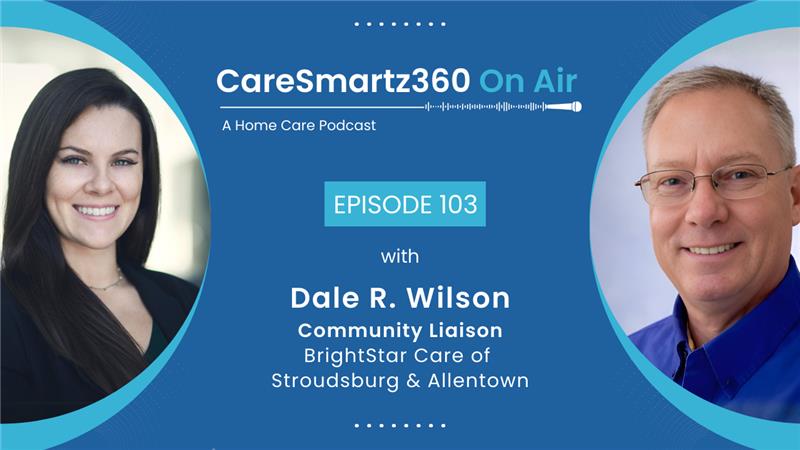
Join us as we welcome Dale R. Wilson, Community Liaison at BrightStar Care of Stroudsburg and Allentown, a seasoned relationship-builder with more than 30 years of experience across business, sales, and senior living.
In this episode, Dale challenges the traditional growth playbook and reveals what truly drives sustainable home care success: trust, partnerships, and community presence. He shares practical insights on turning referrals into long-term relationships, maintaining consistency across multi-location agencies, avoiding common networking mistakes, and preparing for the shifts ahead in 2026.
Trusted by 1,000+ Leading Home Care Agencies


00:00:09
Hello and welcome to CareSmartz360 On Air. I’m Erin Cahill, Sales Account Executive at CareSmartz360. Today we’re diving into the hidden engine behind home care growth and it’s not what most agencies think. Joining us is Dale R. Wilson, Community Liaison at Brightstar Care of Stradsburg and Ellentown. With more than three decades of experience in business sales and senior living, Dale believes growth doesn’t start with marketing budgets, it starts with relationships. Let’s uncover how trust,
00:00:37
partnerships, and community advocacy quietly fuel sustainable home care success. Welcome to the podcast, Dale. >> Thank you very much, Erin. I’m glad to be here. >> Perfect. So, let’s jump right in. What is the real hidden engine behind sustainable home care growth? >> Well, uh, the real hidden engine behind sustainable home care growth is alignment between people and their purpose and the care that they’re going to deliver to the client. Um, and it all starts at the very beginning before you
00:01:09
ever get a client. It starts with investing in the workforce that you’re going to have as the caregivers and the providers of those services. So I think hiring the right caregivers, supporting them and building a culture that’s focused on quality uh becomes the essential piece of it at the foundation. Um when caregivers uh then at that point are are well trained and they’re they’re well positioned, they can thrive in the outcomes that they deliver at the home for the for the
00:01:38
seniors that we provide care for. And it is just you know the outcomes are much more improved. And then from that point it is that growth continues when you look at other intentional growth u service expansions of you know where you are in the marketplace um meaning that if um as you evolve in the community and you recognize what their needs are um you can strengthen your market position. So the more you know about the people you’re serving and the community you’re serving, the better the
00:02:11
better your agency will be positioned for growth. Uh but I think the most critical driver of all that we do in home care is going to be patient centered care. Um I think that a lot of that has to do with how we approach serving the clients that we are in the home to serve. Um, when agencies prioritize the trust that they’re going to extend to the families and the individuals they they come across and serve and their communication is thorough um and the needs of the clients are and and their families of
00:02:45
Of course are uh are upheld and and honored and respected, I think um everything improves. You know, the growth of your agency, the length of stay of that client um all naturally grows from all that. So sustainable grow here is that it’s based on quality care, strong relationships, and adaptability to move in any direction that your agency needs to move. >> Absolutely. And following on from that, how do you turn referrals into long-term partnerships? Well, you know, that that has a couple
00:03:22
of dimensions to it because, you know, your relationships that you develop are both with the community partners you have and with the families that you are working with to serve the clients that you’re um that you’re providing these services for. So, let me take this a little bit further, a little bit more in depth. Turning referrals into long-term partnerships starts with the mindset. You’ve got to go in with a particular frame of mind to do this. And I
00:03:51
don’t see referrals as a transaction. Um, I see them as a relationship. So, everything I’m going to talk about is really focused on relationship building and and really the growth really comes from trusted relationships, but community outreach and networking matter. Um what I want to emphasize on is is that what we do and in and who we do it for uh how we serve those people whether it’s you know um you know in the home or if it’s my interaction with people in the community that are like partners in
00:04:23
The space you know gives an example like people like from Meals on Wheels are also going into the home to provide their services to these people. It really really comes down to um not only providing the essential services for them but also doing so in a fashion and and with a purpose and a mission that really advocates for their needs beyond outreach, beyond partnerships like that. It’s built through collaboration. So I mentioned Meals on Wheels. That’s just one person
00:04:51
or one group I should say that you could partner with because we’re all serving the same people. We’re all in the business of serving people who are home dealing with certain vulnerabilities. So I work very closely with case managers, discharge planners, patient navigators, um other complimentary providers, um I’ll give you examples, hospice, home health, uh physical therapy services where our care enhances what is provided in the home. It doesn’t compete with them. and actually sort of
00:05:26
complements what we all do for these people. Um, but then just sustaining that trust with everybody, with your partners in the community, with the people you’re serving, consistent communication is key, reliability is key, delivering on a higher standard of care is key every single time. So when partners know that their patients are being uh cared for and their families are trusting that we’re in there doing all the support that’s necessary and they’re being truly supported. Um I
00:05:58
think referrals naturally become long-term partnerships. >> Yeah. And how can multilocation agencies build relationship consistency across those branches? >> You know, it’s interesting you should ask that. Um you know um Brightar is a franchise organization. and I work for Brightar Care and it’s a national company that has over 400 locations in the United States to include Hawaii. Um, and every branch needs to operate from the same playbook. Now, obviously, as a brand, as a franchise, we all do that,
00:06:32
but I don’t, it really doesn’t matter to me which agency it is. I think we’re all in this together. Um it doesn’t matter if it’s Brightar Care or other national brands such as Visiting Angels or you know that along those same lines. We all have the same purpose. We all have the same reason for doing what we do. Um so we all share the values. We have clear expectations. Um we have a consistent care model. Um and we’re respecting local community dynamics. So, you know, what happens
00:07:04
Here in the northeast of the United States may be different from what happens in the southeast. So, we have to respect, you know, the differences on how we go to market and who who and how we how we serve the people and how we interact. But, um, if you have multiple agencies, they have different cultures, if you will, different uh certainly different environments weather-wise, um, or just different personalities. Um, you know, people people around the country have different ways of going about what
00:07:29
they do. Some are faster, some are slower, but ultimately it comes down to consistency and it’s reinforced through training, leadership alignment. Um, just so that referral partners and families have the same experience no matter which branch of the organization they’re working with. Um, so strong internal communication is critical when you’re doing this and you’re trying to do it from multiple branch locations. um you know when teams share information either internally or across other branches um
00:08:00
you know they’re trying to do so with some continuity um they’re trying to share best practices there’s a level of accountability um that all has to be universal uh and those relationships across all of those organizations within those branches have to stay seamless across every single location. So the goal simply is basically um that the brand promise in in Brightar Care’s case, we’re a higher standard of care, but you’re delivering it the same way everywhere for everyone with trust and
00:08:32
reliability and patient centered care at the core. >> Absolutely. And what networking stakes are holding agencies back, Dale? >> Another good question. Um, I think one of the biggest networking mistakes agencies are making is treating the collaboration aspect of this as a sales activity. Um, certainly we want to work together and try to earn each other’s trust and try to gain opportunities, but it really starts with relationship building. So I think a lot of people are transactional. I say a
00:09:12
A lot of people I have to be fair to. I have to be fair to a lot of people when I say some of what I’m saying. Um but I think some people are are transactional but not relational if you will. >> Um too often people show up to events for example if you’re networking you know talking about themselves yourself um you know talking about your services which is fine that’s sort of why you’re there. um but they’re not listening and they’re not understanding the needs of that individual or or uh the needs of
00:09:42
the community as a whole. Um so I try to almost forget when I’m at a networking event to even talk about myself. I was in a meeting just a moment ago with someone and I was more interested in what they do and how they do it and who they do it for without asking, you know, hey, maybe we could talk about, you know, what I do. He had to come out and say it. He had to actually say, “Listen, all right, let’s stop, let’s stop and shift gears and go start talking about what you can do.” Um, I think
00:10:09
Another mistake that’s made is people are inconsistent with the service they provide. Um um I think we’re all, you know, we’re all we’re all in this fast-paced world where um mistakes can be made, uh errors, um uh missteps, um consistency is hard to maintain. when you’re dealing with people um so expectations are there but I think you know sometimes we lose we lose sight of or lose grasp of the consistency factor so we have to work harder to do that but um you know in relationships that you
00:10:47
know they require that you’re you’re present that you’re trusted over time and after a while people get used to who you are and what you do and how well you do it that some of those things get I don’t want to say overlooked but they they’re not as they’re not as critical, they’re not as scrutinized as as they as they could be. Um, that’s where strong relationships really come in handy and and and come into focus. Um, but agencies also limit themselves by um, you know, they they try to stay within
00:11:14
their lane and and and and we’re talking about growth of an agency like ours. Um, you know, sometimes you have to nudge out a little bit. Um, and you know, build connections that are outside the norm. Um certainly, you know, build relationships with organizations that complement what you do. I’m ultimately building relationships with people that support the quality of life and the aging in place of those who uh are who we serve. But agencies grow um you know the ones that are going to grow are the
00:11:45
ones that lead with value, show up consistently and focus on serving and not always selling. >> Right? >> Basically one more one more point on that. Let me just say being an advocate for the needs of the people they serve becomes the most important part. The one word I would say is um besides relationship it would have to be advocate. >> And Dale, where can AI strengthen relationship building and where must the human touch remain? So AI AI has become the elephant in the room. Um and um and
00:12:22
we can’t at this point we can’t get away from it. We can’t get around it. We can’t avoid it. Um so AI can absolutely strengthen relationship building. It could strengthen operational consistencies within a home care agency when it’s used in the right way. Um we have to um we have to see AI as improving the efficiencies that we’re trying to gain. Um for example um a lot of companies a lot of home care agencies right now are looking to automate their customer service um aspects of things both online on the
00:13:03
on the website as well as telephone communications. So there’s a lot of um transition from human interaction to computer or AI interaction or automated interaction. Um there’s that includes intake coordination as well. Scheduling and even caregiver recruiting and screening like onboarding new employees, interviewing them is all becoming more automated and more AIdriven. We are not doing that. Brightar Care as a whole is starting to sort of entertain those opportunities and they’re starting
00:13:37
to test those in different markets. Um, our agency hasn’t done it yet. We are looking into it. Um, but these kinds of technologies allow agencies to respond faster, stay organized, um, scale maybe more effectively in what would be a competitive market wherever they are. Um I think that uh AI can support data driven decision-making. I think it could be um it could be essential in identifying trends. Um it could be most importantly it could be essential in in identifying care gaps where we’re we’re serving a client’s
00:14:16
needs. We have a care plan. Um but it may AI may be used in such a way where it’s a tool to identify care gaps uh for this um for our services. Um but at the end of the day whatever AI is used for uh we have to make sure that the that the the impact on the client and on the person interacting with AI is not uh frustrated by it but more importantly that it improves the outcomes that we’re looking for both operationally as a as a as a company but then also as a service provider to our customers. But nothing
00:14:54
will replace the human touch. The human touch must remain at the core of what we do. It should be the center of the care we provide. Um because really human interaction AI is not going to establish trust, empathy and judgment. Um people do that and that’s mutual. That’s interactive. Um computers can’t do that. Um so hands-on support has to be uh a leading tool. I mean, we can’t just use AI for everything, right? Um, you know, building relationships is is one of those things where AI can’t do
00:15:33
that. We have to do that with families and with clients. And, um, you know, if we’re going to do AI, we have to do it appropriately. Um really in terms of AI also um I’m just thinking here um the most successful agencies that use AI will um will keep connectivity quality and compassion in place. Um bottom line sustainable growth with this technology is there for the taking. Um but um we have to amplify humanity. We have to know we can’t replace it. um agencies um will always look to streamline and save
00:16:13
streamline operations basically and and and try to save money. Um but they have to work, they have to support what they’re doing. Um, I’m almost at a loss. It’s hard for people that know me if I’m at a loss for words. Um, but I don’t see AI really um uh I’m kind of tossed at the end of the day with AI and its impact. I mean, what I’ve mentioned I think is essential. I think those things are good. Uh but um but we have to preserve the human connection at the point of
00:16:46
care and trust, loyalty, and long-term growth is is basically more human driven than it is AIdriven. >> Absolutely. Yeah. Well said. And my last question for you here, Dale, what changes should agencies prepare for in 2026? >> So, as well, we’re likely well into 2026 now as we get closer to springtime and 3 months into the year and agencies need to prepare for change. Um, they have to prepare for change on three fronts. Um, workforce, you know, since COVID, workforce challenges, staffing
00:17:20
challenges have always been there. But I think as we continue to move forward, workforce challenges are going to remain and emerge as a um you know it’s going to test the wills of certain agencies and their ability to to scale their business to grow their business. Um the other would be um expectations uh client expectations uh family expectations. Um, you know, there’s going to be changes as people’s needs evolve. Uh, as the as the as the people in society, you know, the older generation face challenges like
00:17:58
dementia and other chronic conditions that are debilitating such as Parkinson’s as an example. Um, I think that, you know, we’re going to have to see that. We have to evolve with those changes, you know. And then the last is our accountability to ourselves and to our marketplace and to the people we partner with our collaboratives if you will. Um we’re going to have to hold ourselves to higher accountabilities in 2026 and beyond. Um because as things get more challenging
00:18:28
and change emerges as a uh as a true test of our ability to sustain not only growth but to sustain our business. Um, I think that we’re certainly going to trip on our shoelaces sometimes, but we have to remain accountable at the same time. Uh, I think recruitment and retention is going to be an issue. Uh, I think that’s going to be our biggest pressure point. Um, I think, uh, agencies need to invest more in the culture of their organization. Um, and to establish a
00:18:59
strong culture. Um they need to focus on training their people and training their people well and remaining consistent on the training that they provide and being um organized and um and intent on making sure that the people they put out in the field are prepared to do what they do. And then we also have to be prepared to be flexible because we can say all these things um but we have to keep it real at the same time. So, we’re going to have to bend and shift and shake uh in the direction
00:19:32
that um the world takes us in. Um I think client and family expectations are going to continue to rise. Um they want faster communication. They want faster results. They want faster starts of care. They want greater transparency. They want uh more coordinated care. Uh they’re going to want things that we can’t provide very easily. Uh so we have to face those changes as they evolve. And it’s going to get a little bit more challenging too. I think family dynamics
00:19:59
and family needs are going to emerge as um big big challenges in the coming months and years. Um and then um agencies that face the increased accountability as I mentioned accountability earlier um on the outcomes that we deliver. Families have these expectations and they want it their way. um you know and and we’re going to try to do it as best we can and in the background we have to do it complying with state regulations and and other um rules that maybe we impose on ourselves and you know we’re still going
00:20:35
to have to be um rigid with those rules but uh flexible for the customer. So how do you balance that right? Um but the agencies that succeed in 2026 are going to need to be adaptable. They’ll have to be data informed and know what the marketplace is calling upon them to do. Um they need to be relationship driven. Um they need to be relentlessly focused on um delivering a higher standard of care and make sure that it’s patient centered. Um, so hopefully I’ve answered your question. I know I
00:21:08
went around and about but um I covered I covered everything that was on my mind there. >> Yeah. No, I think that’s a lot of actionable takeaways and that human connection is so important no matter what comes uh into place with technology and AI like you said. So, um we really really appreciate your time, Dale. Thank you so much. >> I appreciate that. I’m glad to be here. If I can um uh just just a a final thought about all this as we look at the at the theme of of of what we’re talking
00:21:34
about here today. >> I really think that the future of home care belongs to agencies that invest in the people. Um and that’s everybody. I mean the people could be their employees. It could be the clients they serve, the families that and the partners that they uh um they really partner with. Um but to embrace those opportunities to really strengthen those relationships is number one. Um AI is going to be a factor. I can’t get away from it. I think there’s good reasons to employ it in the home care space, but
00:22:05
Everybody’s going to have to embrace smart innovation. I call it smart innovation so that it doesn’t detract from our ability to do what we do and it doesn’t take away from our effectiveness. Um, and never lose sight of the human connection at the heart of what we do. And that’s caring for others. That’s caring for the people we provide services for in the home. Um, and that would be my takeaway from this episode and from what my my philosophies are as I go
00:22:32
my day-to-day routine of trying to inspire people to consider home care as an option to keep people healthy, safe, and happy. >> Yeah, that’s so important. And thank you so much for that message, Dale. And for all of our listeners, uh, this has been CareSmartz360 On Air. Thank you so much for tuning in.
Listen to the episodes on loop for a premium CareSmartz360 on Air experience
 AI Hub