30:07 MINS
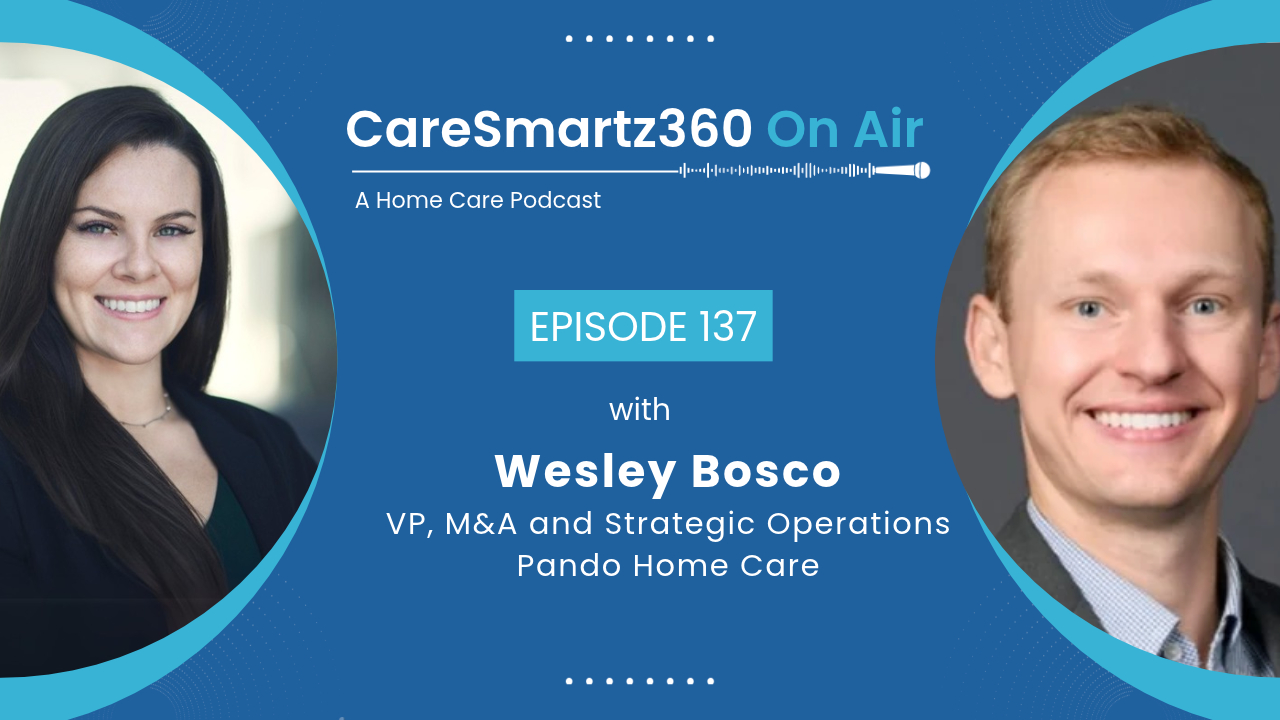
Join us as we welcome Wesley Bosco, VP, M&A and Strategic Operations at Pando Home Care, for a conversation on what makes a home care agency financially healthy beyond revenue growth. Drawing on his experience in private equity, strategic operations, and home care acquisitions, Wesley shares insights into profitability, operational risks, and long-term business sustainability.
In this episode, Wesley explores the key factors that separate financially healthy home care agencies from those simply experiencing revenue growth. He discusses where agencies should focus to improve profitability and long-term stability. He also shares his perspective on strengthening financial and operational performance, along with his predictions for home care mergers and acquisitions (M&A) in 2027 and what independent agency owners should prepare for.
Trusted by 1,000+ Leading Home Care Agencies


00:00:11
Hello and welcome to CareSmartz360 On Air. I’m Erin Cahill at CareSmartz360.
Join us as we welcome Wesley Bosco, VP, M&A and Strategic Operations at Pando Home Care. With a background in private equity, strategic operations and home care acquisitions, Wesley brings a financial and operational perspective on what makes a home care business healthy and sustainable. In this episode, we’ll discuss the numbers that matter beyond revenue, the operational risks that can hold an agency back and how owners can
00:00:40
build a stronger agency for the long term. Welcome to the podcast, Wesley. >> Hi, Erin. How are you doing? Thank you for having me. >> Perfect. So, we’ll jump right here. My first question for you is what separates a financially healthy homecare agency from one that is simply growing? >>>>> Yeah, it’s a great question. It’s very difficult to sustain growth in this industry without having a financial mindset. >> So, the way we like to look at it, it’s
00:01:07
a four-step cycle. I think it even starts with investing in your people, investing in caregivers, investing in competitive wages, investing in your admin employees, having the right training, having the right support, and having the right growth opportunities. That often turns into better-paid, better-trained people who will do better care and better results. Uh, which will then turn into a growing client base and a growing number of hours per week or per month, however you measure them. And then fourth, that will hopefully work if everything else
00:01:38
is done correctly and will turn into a financially successful or profitable business, and then those profits can turn back into investing in your people again. And so, we’ll see businesses that grow at all costs and not follow this cycle. Uh, so they may not be financially healthy. Well, then it becomes hard to sustain that growth. Um, what I like to So, we like to think about growth, having, uh, growth just being a vital part of a business. You almost need to grow, and if
00:02:11
you’re not growing; you’re probably shrinking. It’s hard to stay on the fence. There’s an analogy I like to use, uh, a man who learned how to fly airplanes. They typically do it on gliders, uh, with no engines. And what he said in his remarks was that rising air is what you’re trying to look after when you’re riding or orbiting these planes. And that’s called a lift. When you can lean into the rising air, it will lift you higher. There’s also
00:02:41
the opposite of sink. And when you are not in rising air, you’re in falling air, sinking air due to gravity. And when you’re not necessarily lifting, you’re sinking. And his point was that, uh, you need to always be looking to lift. This is kind of those four things we were talking about. You need to be investing in your people, looking for ways to provide better care, and having the right structure in place to provide and create a financially, uh, profitable business. And if you’re not,
00:03:12
you’re sinking. And so I think over time it’s not just about growing, but it’s about having the right financial metrics in place so that your growth can be sustainable and that everyone can rise together. >> Absolutely. I like that analogy. It makes a lot of sense in this industry, honestly. And Wesley, when you evaluate a homecare agency, which financial metrics tell you the most about how well it is performing? Yeah, going back to the pilot analogy, me
00:03:42
my brother-in-law flies F-16s for the Air Force. So, I got to look in the cockpit one of these one time when I was visiting him, and there are hundreds of buttons, and he even explained if I flip this switch, all of these buttons have different maneuvers, and I can do different things. Well, I think financially I have a finance background. With the advent of AI and the ability to get data and then analyze that data, there are so many metrics to look at, almost too many in an overwhelming
00:04:14
fashion. We love data and we love looking at it. But when we’re helping manage a business and driving some of these area directors, they’re what we call them, but the office leaders be their best; it’s not going to help manage them to hundreds or even dozens of metrics. So, we’ve boiled them down to what we call the big four metrics, which I imagine even in the cockpit as a pilot. There are probably four big buttons or four big metrics that they’re looking at more than other ones. And then
00:04:45
obviously if there are problems, you can kind of DoubleClick and dive a little bit deeper. So I’ll explain to you kind of what these four big metrics are, what we manage our business to, and then also this ties in directly with how we look to acquire business because these are also part of the big four metrics that we look for in new businesses we want to acquire. They need to be healthy in these four things. And if they’re not, then we go and look at underlying data.
00:05:13
to see what is happening. Um, so the first one is new clients. And we started by thinking about this from a net client’s perspective. So, every client that we start to service uh each month minus the ones that lose, whether that’s because someone was hospitalized or someone passed away. Uh, but that’s the way to measure growth. You need to have more clients in the business, getting you more new clients than the ones you’re losing. But the reason we focus
00:05:42
on new clients and not the churn or not the net clients is because in this business there’s a lot that’s very hard to control. We can always control the quality of care and do our best in that way. But people get older, people get sick, and they pass away, or they’re hospitalized, and that’s out of our control. So we like to focus on things that are in our control, and so we focus on new clients. So that’s number one. Number two is billable hours. So it’s not just the
00:06:10
number of clients. Not all clients are created equal. Uh, if we have a new client that needs 24 hours of care a day, it’s very different than one that needs 12 hours a week from a financial perspective. And so we not only look at the new clients, but we look at how many hours each client is actually needing our services. Uh and so we’ll look at the total billable hours, which is just the number of hours each service client needs times the number of clients we’re servicing in our census.
00:06:38
Uh and then third is gross margin percentage. And we look at this in two ways. We call it a burdened gross margin, an unburdened gross margin, and burdened gross margin. Unburdened gross margin is just a simple metric that we like to look at most, which is going to be our bill rate to the client minus our pay rate to caregivers. Uh, that’s going to be the easiest unit economics way of understanding how much profit we get from serving our clients. >>> And then the burden margin is just one step
00:07:09
Below that, where we’re adding in, you know, payroll taxes and workers’ compensation, and sometimes there are gas stipends and incentives that we give to the caregivers or bonuses, that goes just below that. Those are in the our control but a little bit less in our control. A lot of those are government-driven metrics, and we’ll talk a little bit about that later. But we like to look at gross margin percentage, the unburdened around 45 to 50%. That seems to be healthy
00:07:39
uh healthy rate in this market. And then burdened, we’re looking around 35 to 40%, and many things will make that change. That’s why there’s a range. So that’s the third metric. And then the fourth metric is actually hours per local admin employee. So we look at how many hours an office is doing and how many admin employees. So not caregivers but people who are helping with compliance, with scheduling, with operations, or with sales. And we try to get an office in a very healthy range.
00:08:08
here. And I say healthy because this is not a metric where we just want it to be as low as possible or as high as possible, even. We want it to be balanced. If it’s too high, that means there’s a likelihood that our admin employees are being burned out and they’re not going to be able to sustain healthy growth. They are not incredibly happy with their jobs. If it’s too low, we have too many admin employees in the business. And again, they are not happy with their jobs if
00:08:35
they’re not doing the full extent of what they should be on their work. It also probably means this business isn’t growing because over time they’ve hired admin employees, and they haven’t been able to grow into that new set of employees that they pay for. And so over time that could be a profitability issue. So that’s why that becomes the fourth one. And these are the big four. I’d say we look at a lot more data when we’re acquiring an agency. But if those ones
00:09:02
check out, that’s often a particularly good sign that this could be a good acquisition and a good brand in a market that we want to be in. >> Certainly. And, uh, I think any agency can look at those numbers within their business. So that is very helpful. Um Wesley, what operational issues do owners tend to overlook until they start affecting profitability or growth? >> I’ll look at this through maybe those four big four metrics. And there are some operational issues that are within each
00:09:32
of those, which is why we look at these, right? If you look at four of them and three of them are in check and in a good balance, but one of them’s not, we have the ability to double-click on those and understand maybe what’s going on. So, from a new client perspective, uh, just knowing—I would say knowing where your clients are coming from is the biggest, uh, most helpful thing to do. A lot of owners don’t know or don’t have a clear flow of where these referral sources are coming from.
00:10:00
from and how they’re becoming clients. Um, how are these referrals coming from clients from an indirect perspective, like we’re looking at digital marketing? How are people calling into our business and asking us for help? Are they coming through the website? Are they coming through chat GPT? Um are we visiting a hospital and have a great relationship with them or with a skilled nursing facility? right? all of these things. If we don’t know where our clients come from, it’s hard sometimes.
00:10:27
to double down and manage more clients from those referral sources or how to diversify. We had an example in one of our branches. It grew about 60% in a matter of months. It was a small office, so 60% wasn’t; I mean, it sounded a little bit more than it was. Uh, the problem was one of the referral sources or a few of them had gone stale even during this period of growth. And so we were excited, and we were happy with the growth, but the underlying issues were not. I mean, there were still some
00:10:59
underlying issues. Three or four months later, after I think there was a client who passed away and another one was hospitalized, and they were 24-hour clients, all of a sudden we’re back to where we were, maybe even below the previous hours. And we were kind of scratching our heads like were writing this momentum, and we lost it. But that we didn’t see is that some of these referral sources were leaving. So that’s something to always keep an eye on, knowing where clients are
00:11:26
coming from and how to improve. Uh for the second one, billable hours. There are a lot of things here. There are call-offs, uh, cancellations. The client—maybe our management isn’t up to speed, or we’re not checking in on the client. So, when they need more care, we’re not there to help them. So, there are a number of things that could affect how many hours each client is being serviced with, some in our control and some not. But this is an important lever that businesses should
00:11:54
always look to pull when looking to grow their business. Uh, third would be the gross margin percentage. Uh, this is a little bit later, but it is one of the most important metrics for creating a financially sustainable business. There’s this constant healthy and unhealthy tension depending on the business and culture between your scheduling and ops and your sales and marketing people. Uh, the sales and marketing are trying to close as many clients as possible. When people
00:12:28
you offer them to pay, you know, $45, and they say, “Well, someone else is paying 43.” They’re going to try their best to win the deal. So, they might lower their price as much as possible. At the same time, the scheduling and ops are finding the caregivers, the recruiting, and they’re trying to match these, uh, the clients and the caregivers. And sometimes the caregivers are pushing a little bit for a higher wage. And so, to get a good caregiver or to get the right match, ops are looking to staff it as
00:12:56
fast as possible, so they’re willing to go up a little bit. Well, if those aren’t kept in check, >> you’ll see these margins erode and collapse. And that is a big issue because all those dollars you could have gotten go to the bottom line. And if you’re growing fast, you’ll start to realize that >> you may be losing money on every new client you’re getting, which is a dangerous spot to be in for a business. So that’s going to be something that
00:13:23
operationally always intact and having the right guardrails, having the right processes, and having the right culture of that home care is a team sport. We’re all in this together. Making sure we’re all working together. Those are some things that we can do to make sure that margin is the way it needs to be. >> And then lastly is the hours per admin employee. It’s just natural to have admin creep. It’s like a lifestyle.
00:13:50
creep. We want to always pay our employees as much as possible. We want to have fair market rates. We also want to give them bonuses and grow. And everyone wants to be happy. Well, if you’re not growing as a business and there’s fewer financial profit and we’re hiring people, but then we shrink, it becomes very hard to give people raises or bonuses because if we do, that’s cutting into our profit margin even more. And so, this hours per admin employee is a good way to just make sure and check.
00:14:21
that we aren’t overhiring. Um, we’re growing into what we’re hiring for, and if we are shrinking, we’re not overfiring. And so, there are no hard or fast rules here. There’s not even a perfect ratio or metric that we look at, but it’s always important that, um, everyone feels like they’re being stretched a little bit, everyone feels like they’re being compensated, right, and that the business can grow healthfully that way. >> For sure. And Wesley, how much risk does
00:14:50
an agency takes on when too much of its business depends on a few referral partners? You mentioned that a little bit. Um, but it depends on a few referral partners, key employees, or the owners themselves. Yeah, there is always, you know, referral partners. Every type is going to look a little different, right? We’re going to have some fiduciaries, um, geriatric care managers. Those referrals might look a little bit different than a skilled nursing facility. Uh, the clients might be a
00:15:19
little bit looks a little different from the perspective that they may need shorter hours of service for smaller months versus from a fiduciary; those might be more sticky clients and longer periods. So, everyone, everything’s going to be kind of adjusted depending on your strategy and what referral partners are you going after? But with every referral partner, there’s going to be typically kind of a cadence of how often they’re giving you new clients and referrals. And as you get
00:15:51
bigger, you’re also going to be losing more clients faster because you have a bigger census. So, you can almost think of this as a curve of growth. You’re getting one week from a referral partner. Your hours would grow, and then it would plateau. If they’re always providing in one a week, you’re slowly going to probably be losing one a week as your business gets bigger. And so, if there’s too much of that, your business and your overall growth are within a single referral partner and
00:16:18
that contact you have left for a new job, retire, or maybe finding a new referral partner because you’re not meeting quality needs. Well, the quality of service that they need is important. Well, then that growth chart we were talking about before will start to shrink. And if you can diversify that across a lot of referral partners, losing a referral partner here or there is not going to affect your business. But if you are overly, um, I would say concentrated in a single or a
00:16:50
few referral partners, which could hurt your business quite a bit. And so, there are a lot of risks here. here. And when we look at a new agency, we love it; we need to look at the number of referrals they’re getting and the diversification of that. Now, a couple of other referral partners I’ll mention are key, like key employees, like just being able to opportunistically find new referral partners. The word of mouth, just being in your local area and having that brand name very apparent where people have
00:17:20
heard your business, talked about your business, and will refer them. And then honestly, digital marketing is another great one. These are ways to diversify a bit from just pure contacts at referral partners at hospitals. You can create a bit of brand reputation in your market that can get people to come, and that’s more diversified because it’s not one single source, right? Google is going to be found by a lot of different people. So, one thing that I do at Pando Homecare is
00:17:48
is trying to connect the digital marketing, making us feel a little bit more in control there and crisp there so that when calls come in, when people go to our online form leads and over, I mean, Family Matters, one of our brands, has been in the market for decades now. And so, they’ve got a great website and a great presence, a lot of Yelp reviews, and a lot of Google reviews, and we get a lot of clients from this source. And so, it’s one of those
00:18:16
sources that continue to produce and probably will for a long time because of the brand. So, there are ways to diversify, um, referral partners, and I would always just urge, uh, owners to start with one but look to diversify not only the type of referral partners, like different skilled nursing facilities, but also the type of referral partners, like fiduciaries, digital marketing, and right word of mouth, looking for opportunities to expand that and to derisk your business. And Wesley, for an owner who wants to
00:18:51
build a more sustainable agency. Which financial or operational area should they focus on improving first? >> I mentioned earlier the margin being one of the more important metrics to look at of those big four. I love margins. It’s a sustainable financial metric. Uh, I’ll dive into the levers we can pull within an unburdened and burdened margin now that we’ve discussed that a bit. So, in an unburdened margin, as I mentioned before, it’s just the bill rate that they pay the caregivers. Sorry, the
00:19:23
bill rate they ask for from the clients and then the pay rate that they pay for the caregivers or target, like I said before, is about 45 to 50%. Uh, one lever you can pull here is just knowing those numbers and tracking them. There are sometimes different agencies that will have different service types, such as short shifts and live-in cases; sometimes there’s a home health element. There are different products or business lines. And so just knowing your margin and what you’re making per
00:19:59
unit of service for each of those is important. And the lever you pull here is making sure you have the guardrails with your sales and sales and ops. Like I mentioned earlier, whether that’s a rate card or just guiding principles that your business can work through to make sure that they’re always maintaining good margins. It’s also important to know that, hey, short shifts may have a really high margin but really low hours, and maybe living cases have a lower margin but really high hours.
00:20:30
And so just knowing that and knowing what our strategy should be to go after so that our business can be long-lasting and sustainable. That’s an important metric to know. And then next on a burden margin, uh, there are a couple of things levers to pull here. Again, this is going to be closer to 35%, so that’s 10% from the unburdened margin to the burden margin. 10% is going to payroll taxes for workers’ compensation, and maybe we must subcontract caregivers. Uh, we’re paying.
00:21:04
benefits like health insurance or 401(k)s for the caregivers. Sometimes, like I said before, a gas stipend or some sort of incentive or bonus. Well, the way to manage that, uh, a lot is uncontrollable. A lot of its government legislation is dictated by legislation. But payroll taxes: one thing many people don’t know is you pay unemployment taxes for the first $7,000 in caregiver wages. So, if you have a high turnover of caregivers in your business, you actually pay more in
00:21:37
payroll taxes than an agency that has a long caregiver tenure. So that’s something you can control. I mean, you can treat your caregivers right. Uh, make sure that they are staffed and make sure that they have a great experience working for your agency, that they know what your values are, that they know that high-quality care is what you’re expecting, and that you hire the right caregivers. All of these things can affect how much you pay in payroll taxes because they will stay.
00:22:02
longer. Uh, workers’ compensation. Again, you can’t control class code rates, which is what insurance companies use to kind of bill those payments, but you can control how many claims you have or how you triage those claims, whether it’s training, safe transfer practices, making the right match, or, um, whether it’s, you know, you have a caregiver that gets hurt and you give them a couple of days off and you give them something to make sure that they’re doing okay before they come
00:22:34
back to work. There are ways to derisk the workers’ compensation, and we’ve seen it in our business over time, and just lowering that percentage over 15-20 million of caregiver wages across the business can have a really big impact on the bottom line. And then one more thing I’ll mention is the benefits. Health insurance and 401k. Those are actually costs to the business. Uh, and so you may be thinking that those are bad, but those may be actually good costs because if you can have more caregivers on your
00:23:05
health insurance or your 401k, they’re probably going to be more loyal to you, to your agency, and to your brand, which would lower a lot of other costs within the business. So, that may be a cost that would increase overall burden margin but have better and more positive effects over the long run in the business. >> Sure. Yeah, that is so helpful for so many of our agencies listening, I’m sure. Uh Wesley, and my last question for you here today: what’s your 2027
00:23:35
prediction for home care M&A? And what should independent agency owners prepare for? >>> The market is where I come from, a background of M&A from a lot of different industries and not just home care. And it’s always so difficult to predict markets. There are interest rates in broader economic ups and downs, macroeconomic trends, and political cycles. There’s a lot that’s going on in home care, too. Specifically, home care is interesting because it’s very fragmented.
00:24:09
and I think that it will continue to be very fragmented over time. Even though there might be some consolidation that takes place in the market, the number of home care organization licenses that are given state by state is growing; this industry is growing. So instead of focusing on exactly how I think M&A will turn out, I may just say what I think won’t change in 2027 and it won’t change in probably the next 5 years. Uh, a strong, healthy business will find a
00:24:41
buyer that will pay the market rate for it. And that’s the bottom line. And for businesses, the other way that an M&A could happen, or a sale of a business could happen, is that businesses are losing money and getting squeezed and needing to sell because if they don’t sell for a discount, they’ll get shut down. That is not a fortunate thing, but that also happens in the industry. So, let’s focus on maybe what business owners can do to have a strong, healthy business that those buyers like ourselves
00:25:11
at Pando Homecare, other buyers are looking for it. Uh, we typically see two types of owners that are looking to sell their business. Uh, one type is going to be ones that are ready to retire. These are typical owners that have been in the business for 20-25 years, have built an amazing business, but are looking to actually step away and get a fair price for their business and then leave. Uh, they—what matters most to them is speed. They want to be close with certainty. They want as much cash at close as possible and not
00:25:45
have any uncertainty with the finances? Maybe they’ll stay on for a month to 3 months, but then ultimately, they don’t want to stick around in the business. They’ve given their time, and they’re ready to give up. They also just want their legacy to last, and they’ve spent years in the community. They don’t want their reputation to be tarnished by the new buyer. Uh, so a good buyer understands that, and they want to make sure that that stays intact. The second type of
00:26:13
seller or owner that looks to sell is one that’s looking for some change, but maybe they’re not quite finished yet and they want to grow. So, they just want some fuel for their fire, I’d say. Um, these are people that might, for example, be in our family matters office: the mom, Carol, retired, and her son, Jacob. Other members of the family have remained in the business and are growing it. And so, that’s kind of, I guess, type one and type two there. But there’s a lot of opportunity too to find a buyer.
00:26:49
that has the right vision and the right mission and that can actually grow this business to be bigger. And so those are what I would say would be the two types. Not every buyer is going to be the same, and it’s always going to be important to find the right buyer for you, the right structure. Uh, we typically at Pando Homecare like to do a seller-friendly buy, which is going to be more cash at close. We like to push towards 90% at close. That’s all that’s not always the case. That’s not always
00:27:21
happening. Um, but we like to push that way because owners typically feel more comfortable with or sellers feel more comfortable about that. The other ways we sometimes can structure a deal would be with seller financing or earnouts. Uh, something to watch out for with owners and seller financing. I just talked with an owner who sold their business for $4 million a few years ago. Most of it was not cash at closing. So he didn’t get a lot of money right away, but it was financed through seller financing.
00:27:53
note. And over a short period of time, the buyer ran that business into the ground, going from $4 million to $400,000. And because he had the seller’s note, he got his own business back. The problem is he got his business back with 10% of the value or the revenue, and he wasn’t really paid for the value he had created. So that was a really sad thing to hear, and that’s one reason why we look to be a little bit more seller-friendly. We’re confident in our ability to maintain a legacy to grow a
00:28:24
business and to create really good terms with the seller who knows everyone in the market who has other people who are in their same boat looking to sell their business. And so I guess I’ll end with just a few pieces of advice for owners coming, you know, looking to sell. It comes down to three things. I would just worry about what you can control, not what you can’t. Uh, try to get your business. We talked about four big metrics. Try to get your business in a healthy state.
00:28:53
If it’s in a healthy state and you’re looking to sell in the future, you’ll be able to find a buyer. And then I would also just say, “Uh, focus on some of the things you would if you weren’t selling. Like you don’t always have to have the mindset of selling. And a lot of times keeping the business is fantastic. So build a large, growing business, a healthy business where your employees, caregivers, and admin employees are healthy and happy and grateful to be there, and all everything else will kind
00:29:22
of the workout. And then know your buyer when there is a buyer at the end of the table. Just what is the likelihood of close? What is the deal structure? Can you trust them? Can the buyer trust you? Those are some important things to remember. Uh and when the time comes, you’ll be able to make the right decision. That is so helpful, Wesley, uh for all of our agencies tuning in to not only continue growing their business but also to be ready when the time comes if they want to sell. So, we really
00:29:48
Appreciate you taking the time to help us out with that. Um, very actionable takeaways. >> Thanks, Erin. It was great having you. Thank you for having me. >> Yeah. And for all of our listeners, thank you for tuning in once again to CareSmartz360 On Air, and we will see you again soon.
Listen to the episodes on loop for a premium CareSmartz360 on Air experience
 AI Hub