Blog
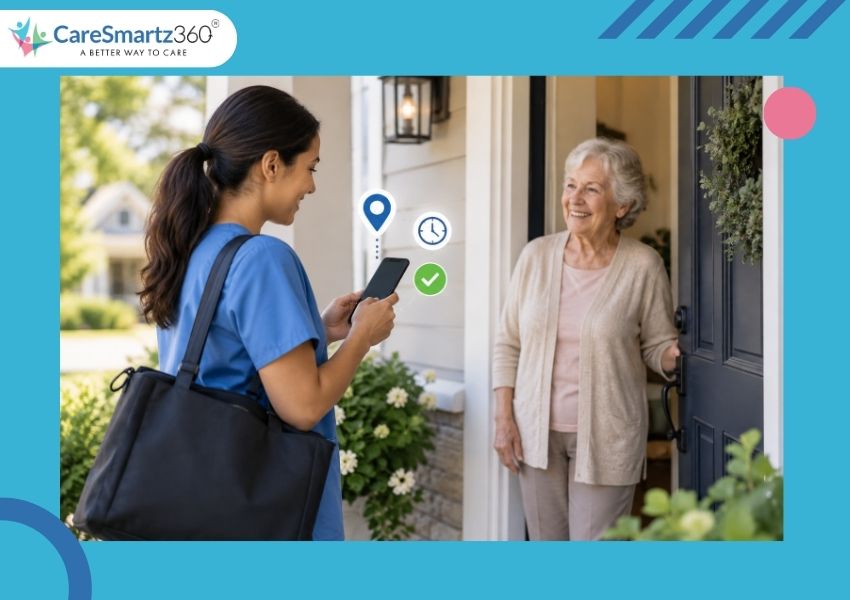
Electronic Visit Verification (EVV) is now mandatory for most Medicaid-funded home care.
However, EVV compliance alone doesn't solve the problem.
If verified visits still require manual corrections before billing, agencies lose hours every week.
And eventually end up delaying reimbursements. That’s why choosing the right EVV system matters as much as meeting state requirements.
At its core, EVV confirms that a scheduled visit took place by recording information such as the caregiver’s check-in and check-out time, visit location, and service details.
For agencies, however, EVV is about much more than meeting a federal requirement.
The quality of your EVV system affects caregiver workflows, office efficiency, billing accuracy, and ultimately cash flow.
A visit that’s verified but doesn’t make it cleanly into billing still creates unnecessary administrative work.
This blog compares some of the leading home care software with built-in EVV capabilities. It explains what separates a reliable platform from a basic compliance tool.
It also outlines the questions every agency should ask before making a decision.
Rather than comparing the longest feature lists, we focused on the factors agencies deal with every day.
Each EVV system was evaluated based on the following:
Instead of asking, which platform has the most features? The better question is, which platform removes the most amount of work for our staff while keeping us compliant?
NOTE: This comparison is based on publicly available product information. Features, state integrations and pricing can change, so agencies should verify current availability directly with each vendor.
An EVV system is a regulatory and technological system. It is designed to electronically verify the type of service, the individual receiving the service, the date of service, the location of service, the individual providing the service, and the time the service begins and ends. Visit duration is calculated from the recorded start and end times. But it is not itself one of the six named EVV elements.
Many platforms advertise GPS verification, but GPS alone doesn’t make an effective EVV solution.
A reliable system should reduce administrative work while making compliance almost invisible to caregivers.
| Requirement | Why it matters |
|---|---|
| State aggregator compatibility | Every state manages EVV differently. Confirm that the integration already exists rather than relying on future roadmap commitments. |
| Offline functionality | Caregivers frequently work in rural communities, apartment buildings and locations with poor reception. Visits should continue recording even without internet access. |
| Direct billing integration | Verified visits should move directly into claims, reducing duplicate data entry and documentation errors. |
| Simple caregiver experience | Clocking in should take seconds. Complicated workflows often lead to missed visits and compliance issues. |
| Flexible verification methods | Depending on payer requirements, agencies may need GPS, telephony, or multiple verification options. |
As more and more home care agencies move towards strict compliance structures, it becomes imperative to focus on operational intelligence as well.
CareSmartz360 is designed for large and enterprise home care agencies that want scheduling, EVV, billing, payroll, caregiver management, and operational visibility within one platform.
EVV & operational capabilities: CareSmartz360 supports 45+ state EVV integrations, along with GPS-enabled visit verification, telephony and offline functionality. Its EVV solution captures visit information at the point of care and connects verified visit data to downstream billing and payroll workflows.
The platform also provides operational tools beyond EVV, including scheduling, caregiver management, reporting and Care First AI capabilities such as AI Smart Scheduler, AI Voice Bot, AI-assisted Note Writing and AI Care Insights. These tools address scheduling, shift confirmation, documentation and operational oversight rather than EVV compliance itself.
Potential consideration: Agencies should confirm that the specific integrations, payer workflows, and state EVV requirements they need are supported for their operation.
AxisCare combines scheduling, EVV, billing, reporting, caregiver communication and client/family access within one platform. Its caregiver app supports scheduling, clock-in/out, visit documentation, GPS and EVV workflows. AxisCare also describes offline functionality for its caregiver app.
Its billing tools cover private-pay and third-party workflows, with additional Medicaid and VA billing capabilities.
Potential consideration: Agencies should evaluate which billing, EVV and integration capabilities apply to their specific payer mix and operating model.
AlayaCare brings scheduling, EVV, documentation, client information and billing into a broader home care operations platform. Its mobile app provides field teams with schedules, client context, EVV and point-of-care documentation, with offline capabilities also documented by the company.
The platform is positioned around connecting authorizations, scheduling, EVV, documentation and billing workflows.
Potential consideration: Agencies should assess which parts of the platform they need and how its broader functionality aligns with the complexity of their operation.
ShiftCare focuses on scheduling, workforce coordination, caregiver communication and field operations. Its mobile offline mode allows caregivers to view downloaded shift information and clock in or out without an internet connection.
ShiftCare also provides state-specific EVV setup resources covering states including Colorado, Wisconsin and Maine.
Potential consideration: Agencies should confirm the exact EVV, billing and payer workflows available for their state and service model.
Alora combines scheduling, EVV, billing, payroll, documentation and caregiver management in one platform. Its EVV offering supports both GPS and telephony, with EVV information connected to billing and payroll workflows.
The platform also supports offline functionality and describes capabilities for agencies operating across multiple offices.
Potential consideration: Agencies should clarify which parts of Alora's broader home care and home health functionality apply to their specific non-medical home care operation.
CareVoyant connects scheduling, authorization, EVV, billing and payroll within its platform. Its mobile EVV solution supports clock-in/out, visit verification and offline functionality. While its reporting tools provide visibility into visit and billing information.
The platform is designed around connecting operational and revenue workflows rather than treating EVV as a standalone process.
Potential consideration: Agencies should evaluate the platform against their specific service types, operational workflows and implementation requirements.

CareSmartz360 fits agencies looking for a home care management platform that brings core operational workflows together rather than relying on separate systems for scheduling, EVV, billing, payroll, caregiver management and reporting.
Its CareFirst AI tools add another layer for agencies looking to apply AI to specific operational tasks, including scheduling, notes, care insights and voice-based shift confirmation.
Many agencies start by comparing software features.
A better starting point is the state’s EVV requirements.
It’s not unusual for an agency to spend weeks evaluating products only to discover that one doesn’t integrate with the state’s required EVV aggregator. Verifying compatibility first often eliminates unsuitable options before product demonstrations even begin.
Once that’s confirmed, compare caregiver experience, billing workflows, reporting & overall operational fit.
Sandata is often mistaken for a home care management platform. Depending on the state’s EVV model, Sandata may serve as the state-provided EVV system, the state aggregator, or both. Agencies using another home care platform should confirm whether it automatically transmits required visit data to Sandata.
Your agency’s software still handles scheduling, caregivers, billing, payroll & daily operations. The software simply submits required visit information to Sandata or another state-designated aggregator when necessary.
Before selecting any platform, ask whether those submissions happen automatically or require manual intervention.
Learn more about our integration partners. Check the list of tools available to strengthen your existing home care operations.
Product demonstrations often focus on features. These questions usually reveal more about how the system performs in practice.
Pricing is another area where EVV platforms differ. Some vendors include EVV as part of the core platform, while others may charge separately depending on the features, state requirements or services involved. Before making a decision, agencies should understand what is included in the subscription and whether additional costs apply later.
Different agencies prioritize different capabilities.
If you’re a startup or small agency
Focus on ease of use, quick implementation & caregiver adoption.
If you’re primarily private duty
Look for strong scheduling, payroll, billing, CRM and caregiver management alongside EVV.
If Medicaid represents a significant portion of your revenue
State integrations and billing workflows should carry more weight than additional operational features.
If you provide skilled nursing or therapy services
Clinical documentation and EMR integration become just as important as EVV itself.
If you operate multiple offices or service lines
Reporting, user permissions & scalability become increasingly important as your organization grows.
The best EVV software isn’t necessarily the one with the longest feature list. It’s rather the one that best fits your agency’s operations. And ensuring compliance is easier for both caregivers and office staff.
To put things into perspective, compliant visit records help agencies support timely reimbursement. Operational efficiency, on the other hand, keeps you profitable. So make sure you have a good balance of both.
Start with your state’s EVV requirements. Confirm the platform already supports the necessary integrations. Then evaluate caregiver usability, billing workflows, reporting and long-term scalability.
A system that ensures manual work does not act as a bottleneck delivers more value than one that focuses only on compliance.
Before seeking best value electronic visit verification software with integrated scheduling or directly a product demo, make a shortlist based on your state’s EVV requirements and your agency’s service mix.
Suppose you’re comparing platforms that combine EVV with billing, payroll & caregiver management too.
Seeing how those workflows connect in a live environment can make the differences much clearer than a feature checklist alone.
CareSmartz360 can be a fit for large home care agencies that want EVV connected with scheduling, billing, payroll and reporting in a broader home care management platform. Agencies can evaluate its capabilities based on their specific state requirements, payer mix and operational needs.
Federal law requires states to implement EVV for Medicaid-funded personal care and home health care services that require an in-home visit.
CareSmartz360 connects EVV data with payroll and billing workflows, helping agencies use verified visit information to support caregiver pay and client billing within the same home care management platform.
Download Blog

 AI Hub

