Blog
EVV is not new. The federal requirement dates back to the 21st Century Cures Act. What is changing in 2026 is the level of state monitoring and, in several states, the connection between EVV performance, corrective action, claim processing and provider oversight.
For agencies operating across state lines, that means managing multiple Medicaid EVV frameworks at once. Aggregators, manual-edit standards, claim-validation rules, and enforcement dates can differ from one state to another.
This guide examines 11 states where EVV thresholds, claim validation, aggregator workflows, or enforcement practices have changed, tightened, or entered a significant transition during 2026. It also outlines the operational adjustments multi-state agencies should consider.
Regulatory note: State EVV policies and enforcement practices can change throughout the year. This article reflects guidance available as of September 2026 and is intended for general informational purposes. Agencies should verify current requirements with the relevant state Medicaid agency, payer, or EVV administrator. Developments supported only by industry reporting are identified accordingly.
Monitoring is tightening in several states, although the mechanisms and consequences differ substantially. Several states now use EVV/claim matching or other claim-level validation that can prevent payment when required EVV data is missing or doesn't match. Ohio provides a clear example of claim denial on an EVV mismatch, while Texas requires an accepted matching EVV transaction before an EVV-required claim can be paid. Illinois, meanwhile, has introduced a 75% quarterly compliance threshold backed by escalating enforcement.
The manual-edit trap: In several states, manual edits are now receiving more direct compliance scrutiny. Pennsylvania sets an explicit 15% threshold, Michigan measures verified visits without manual edits, and Texas incorporates manually entered transactions into its EVV Usage Score.
Multi-state risk: A blended, agency-wide number won't protect you. You need per-state and, in some cases, per-payer tracking, verified aggregator connections, and reporting that looks at each state's metrics individually.
Agency leaders don't usually think in terms of individual EVV data fields. They think in terms of revenue cycles, claim rejections, audit liabilities, staff workload, and whether their software vendor is actually ready.
The 2026 EVV changes touch each of those areas.
In states where EVV data is directly tied to claim payment or claim validation, a mismatched visit record can prevent the claim from being paid until the EVV issue is resolved.
Ohio provides a clear example of this model, while Texas requires a matching accepted EVV visit transaction for EVV-required claims.
For a multi-state agency, repeated claim mismatches can therefore become a cash-flow management issue, particularly when rejection queues accumulate across multiple billing cycles.
Some state programs previously allowed claims to continue through processing despite certain missing or mismatched EVV information, giving providers additional time to address exceptions.
In states where EVV data is directly tied to claim payment or claim validation, such as Ohio and under Texas's current matching requirement, the opportunity to resolve an EVV problem before it affects payment has become narrower.
It's worth being precise here, though this shift is not universal. Pennsylvania and Michigan, for example, still permit manual corrections; they've simply tightened how those corrections are monitored and when additional compliance action can occur.
Illinois takes a different approach in its cited 2026 policy, using a quarterly compliance threshold with escalating enforcement rather than establishing a universal claim-denial rule for EVV mismatches.

As EVV and Medicaid oversight become more closely tied to documentation, coordination, and reimbursement, operational gaps can quickly become revenue risks.
Aggregator note: HHAeXchange acquired Sandata in 2024. State programs may still identify Sandata by name in their EVV materials, so this article uses the aggregator name specified in the relevant state guidance.
Live: April 1, 2026
Who is affected: Covered State Plan HHCS provider agencies billing fee-for-service Medicaid, HealthChoice Illinois MCOs, and FIDE SNP MCOs.
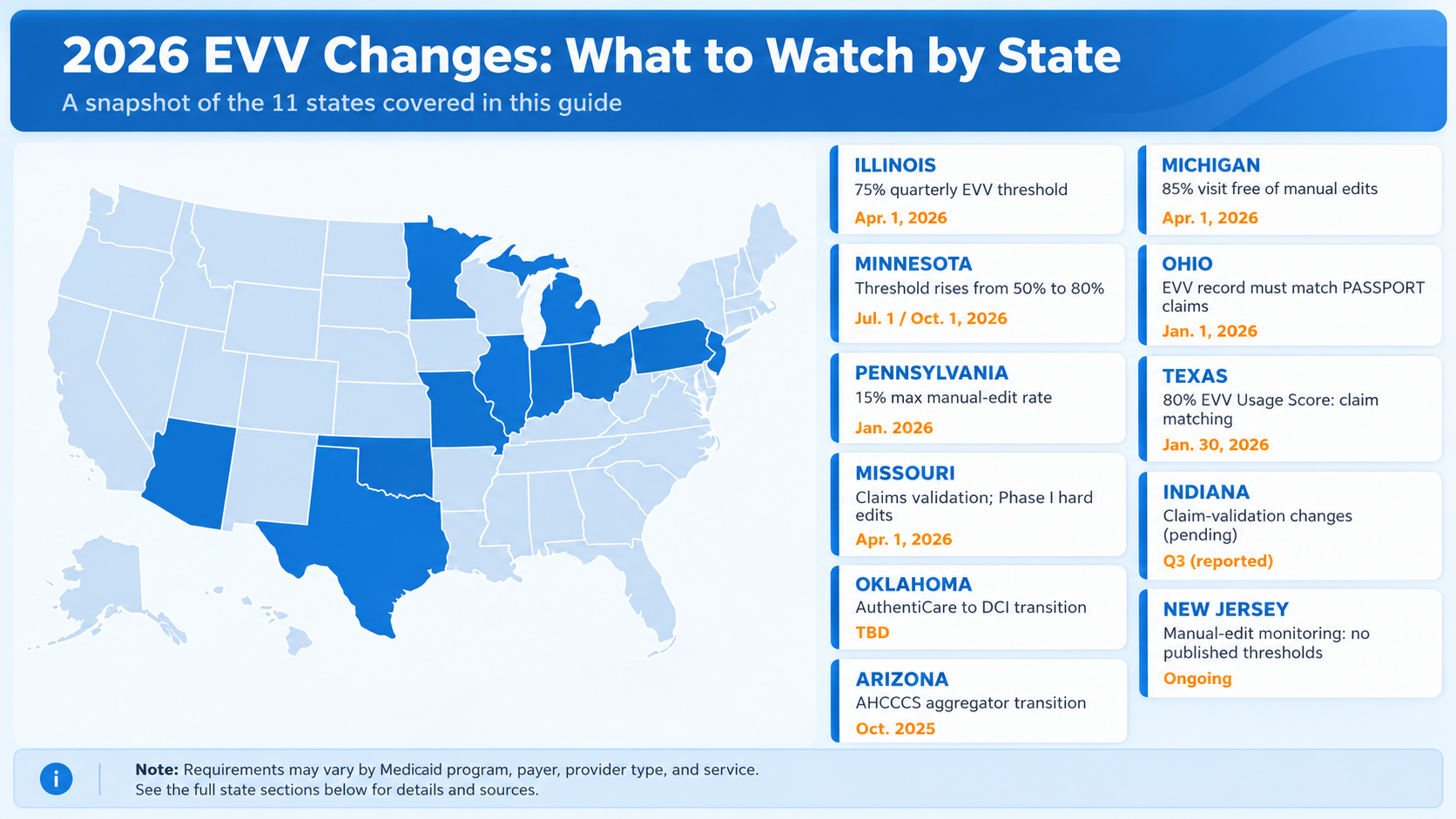
Illinois HFS updated its EVV policy in February 2026. Beginning April 1, covered State Plan HHCS provider agencies must achieve a 75% EVV compliance rate each state fiscal year quarter. The percentage is calculated using visit data from the start to the end of the applicable quarter and does not roll over between quarters.
The policy applies specifically to the provider and payer populations identified in the notice. Illinois states that updated EVV policies for other HHCS and Personal Care Services waiver populations are forthcoming. Agencies should therefore not automatically apply this 75% threshold to every Illinois Medicaid program.
The enforcement process escalates based on quarterly noncompliance:
The notice describes these as the first, second, and third quarterly noncompliance occurrences. It does not state that they must be consecutive.
Illinois uses HHAeXchange as its state aggregator. Agencies using third-party EVV systems should verify that required visit data is successfully reaching the state system rather than relying only on the status shown in their own software.
Learn more about Illinois EVV requirements and compliance updates.
Live: January 1, 2026
Who is affected: Providers submitting applicable PASSPORT Waiver claims.
Since January 1, 2026, claims for applicable PASSPORT Waiver services have required a matching EVV visit record during claims adjudication. Claims that do not have the required matching EVV record are denied.
This represents one of the clearest examples of EVV data being directly connected to claim payment.
Ohio's EVV materials identify Sandata as the applicable EVV system/aggregator for the relevant program. Providers should verify the applicable Ohio EVV requirements before submitting claims.
A note on 2026 changes: This discussion focuses on the rules currently established by Ohio’s published guidance.
Live: January 1, 2026 (managed-care billing transition) | April 1, 2026 (85% threshold enforcement)
Who is affected: Providers subject to Michigan's applicable managed-care EVV requirements.
Beginning January 1, 2026, Michigan's Comprehensive Health Care Program requires billing for applicable managed-care home health services to be transmitted through HHAeXchange.
As of April 1, 2026, MDHHS requires providers to maintain at least 85% of verified visits, per payer and per quarter, free of manual edits. Michigan's monthly reports are used to calculate quarterly compliance, and providers associated with multiple payers receive reports for each payer.
This is scored separately for each payer. If an agency bills through multiple applicable payers, it should not assume that a strong blended average across all payers will satisfy each payer-specific requirement.
A visit with one or more relevant manual edits is treated as a noncompliant visit for the purpose of the calculation.
Michigan's 85% standard is tied to compliance monitoring and corrective action under MMP 26-10. Payment consequences depend on the applicable program and billing workflow; the supporting material does not establish EVV-based payment consequences across all PCS programs.
Formal quarterly reviews occur throughout the year using the applicable compliance reporting process.
Live: January 1, 2026 (50% target) | July 1, 2026 (80% target)
Who is affected: Providers delivering Minnesota Medicaid services that are subject to EVV, including applicable personal care, waiver, and home health services.
Minnesota DHS phased in its EVV compliance requirements in 2026:
DHS reviews compliance quarterly. Providers receive monthly compliance reports and are responsible for monitoring their own performance and correcting issues before corrective action is required.
The requirements do not apply indiscriminately to every PCA-related service. Agencies should confirm which services are subject to EVV and which are excluded under current Minnesota guidance.
Minnesota uses a hybrid model. Providers may use the state-provided HHAeXchange system or an alternative EVV system that meets state requirements, but applicable providers must enroll with HHAeXchange and submit required visit data through the state aggregator. Agencies evaluating their setup can review Minnesota EVV software requirements as well.
The mid-year step-up creates a tracking risk for multi-state operators: a performance level that met the January threshold may no longer meet the requirement after July.
Live: January 30, 2026 (revised usage requirements)
Texas requires a minimum 80% EVV Usage Score each state fiscal quarter.
The score incorporates manually entered and rejected EVV visit transactions. For program providers and applicable PSOs, the score combines the Manual EVV Visit Transaction Score and Rejected EVV Visit Transaction Score.
Texas also requires an EVV-required claim to have a matching accepted EVV visit transaction before payment can be made. If the required claim data does not match the accepted EVV visit transaction, the payer will deny the claim.
Agencies should verify that their workflows align with the applicable Texas EVV requirements.
Plus, providers that fail to maintain the 80% score may receive a notice of noncompliance and face progressive enforcement based on repeated occurrences.
Texas has also ended the compliance grace period during which payers did not initiate enforcement for failure to meet suspended EVV requirements. The change took effect January 30, 2026.
The end of that grace period should not be confused with Texas's visit-maintenance and exception-handling processes. Agencies still have processes for correcting EVV transactions; the difference is that the previous suspension of compliance enforcement no longer applies.
Live: Ongoing 85%/15% standard | New alerting, effective January 2026
Pennsylvania requires providers to keep at least 85% of verified EVV records free of manual edits, in other words, manual edits cannot exceed 15%.
Starting in January 2026, the Department of Human Services began issuing alerts to providers whose manual-edit rate exceeded 15% in the previous quarter.
For fee-for-service providers, exceeding the 15% manual-entry threshold for two consecutive quarters results in a formal notice of noncompliance and requires a corrective action plan. Managed care organizations have corresponding monitoring and corrective-action responsibilities for network providers.
Pennsylvania uses Sandata under an open model.
If you also operate in New Jersey, note that New Jersey has not published a hard percentage limit comparable to Pennsylvania's 15%. Industry sources report that New Jersey is monitoring elevated manual-edit rates. But agencies should confirm current state expectations directly rather than applying Pennsylvania's 15% standard to New Jersey.
Live: Soft launch began January 7, 2026 | Phase I hard edits began April 1, 2026
Missouri began a soft launch of EVV claims validation on January 7, 2026.
The state's claims-validation process gives providers an opportunity to identify and correct EVV issues before hard edits take effect. Providers have been encouraged to review their remittance information and EVV Aggregator Solution records to identify potential claim denials.
Phase I hard edits began on April 1, 2026. Under Phase I, claims for EVV-required services authorized by the Department of Health and Senior Services, Division of Senior and Disability Services, for provider types 26 and 28 are denied when no matching visit exists in the EVV Aggregator Solution.
Later phases apply to other populations, including Home Health Care Service providers and Department of Mental Health Division of Developmental Disabilities providers. The timeline for those phases is to be provided later.
The state's validation process can identify issues such as provider or participant ID mismatches, unmatched units, missing visits for the relevant procedure code and date range and visits that have not reached verified status.
Missouri uses the EVV Aggregator Solution, powered by Sandata, to collect and review EVV data.
Status: Q3 2026 reported for Indiana | Oklahoma implementation timeline not finalized yet
Indiana may start checking EVV claims more closely in the third quarter of 2026. Some industry sources say these checks could look at things like caregiver credentials and service codes. However, Indiana Medicaid has not officially confirmed these details yet.
So, don’t treat these changes as final until Indiana Medicaid confirms them.
Oklahoma is replacing its current EVV system, Fiserv's AuthentiCare, with Acumen's Direct Care Innovations (DCI).
Oklahoma has confirmed the transition, but officially, the implementation timeline has not been finalized.
The transition will take place through multiple stages, including design, development, testing, and implementation. Oklahoma says stakeholders will receive updates as the timeline is established.
Separately, Oklahoma's live-in caregiver EVV exemption ended October 1, 2025, for the specified DDS services. Applicable services now require EVV, and manual entries are not considered compliant for that program.
Agencies operating in Oklahoma should therefore prepare for the system transition while avoiding a fixed implementation date until the state publishes one.
Status: Industry-reported monitoring
New Jersey has not published a specific limit for manually entered visits. In fact, industry sources report that agencies with consistently high rates may receive additional scrutiny.
Because this development is based on industry reporting rather than a confirmed state percentage threshold, agencies operating in New Jersey should confirm current expectations directly with their Medicaid program or EVV administrator rather than applying Pennsylvania's 15% standard to New Jersey.
Status: State EVV aggregator transition launched October 2025
Arizona launched the AHCCCS EVV Aggregator in October 2025 after ending Sandata's role as the state-sponsored EVV vendor and aggregator. AHCCCS's transition materials explain that EVV vendors now send data directly to the AHCCCS aggregator.
Provider agencies must use an EVV system and share required visit data with the AHCCCS aggregator. AHCCCS allows providers to choose an EVV vendor rather than requiring all agencies to use a single vendor.
Agencies should confirm that their selected EVV vendor meets AHCCCS requirements and is successfully transmitting data to the AHCCCS aggregator.
The current AHCCCS list of alternate vendors actively transmitting data includes CareSmartz360. AHCCCS explicitly states that the list is not an endorsement and that providers are responsible for their due diligence when selecting a vendor.

Medicaid requirements are changing across states. Explore the 2026 compliance issues, EVV requirements, key dates, and operational considerations home care agencies need to track.
Across several of the states covered here, manual data entry is becoming a more visible part of EVV compliance monitoring.
Pennsylvania sets an explicit 15% threshold. Michigan measures verified visits without manual edits. Texas incorporates manually entered transactions directly into its EVV Usage Score. New Jersey is also reported to be monitoring elevated manual-edit rates, although it has not published a comparable percentage threshold.
For agencies trying to reduce manual edits, the operational goal is straightforward: use an approved live clock-in/out method whenever possible and resolve exceptions close to the time of the visit.
Don't treat EVV audits as a once-a-quarter task. Multi-state agencies should monitor this data monthly, ideally before a state's reporting window closes.
Check field completeness. Match billed visits against state-specific requirements. The federal floor includes six required EVV elements, but individual states and programs can layer on additional requirements. Build internal checklists around the specific programs and state guidance that apply to your agency.
Monitor aggregator sync. A visit that appears complete in your own software may not have been accepted by the state’s EVV system or aggregator. Confirm successful transmission rather than relying only on the visit status displayed internally.
Track manual edits by state and, when needed, by payer. Take Michigan, for example. It measures this per payer rather than using one agency-wide number.
Check EVV usage by individual caregiver. Manual entries may be more common around specific caregivers, shifts, or offices. Agency-wide averages can hide these numbers.
Match claims directly to accepted EVV visit records, particularly in states with direct claim/EVV validation or matching requirements.
Run this before every applicable state reporting or submission window closes.
Pipeline linkages
Record quality checks
Manual override analysis
Match reconciliation
Target calendar check
Track EVV usage in the field

Learn how to build a daily EVV validation process around visit accuracy, billing alignment, exception resolution, and the metrics that can reveal revenue leakage before claims go out.
Most EVV software for home care agencies describe themselves as "compliant" which is a low bar if you operate across several states.
For a multi-state operation, the more useful question is whether the platform can manage state-specific requirements without forcing your entire organization into one workflow.
When evaluating a home care software platform, ask for these things specifically:
How does it handle real-time visit capture?
Visits should be logged and location-verified using an approved method at the time of the visit.
Which state aggregators does it actually connect to, and how?
Ask the software vendor to demonstrate how data moves between its platform and the EVV systems or aggregators used in each state your agency serves.
Does it separate compliance metrics by state and payer where required?
A single blended agency-wide score isn't useful for multi-state operations.
Can data submission accommodate state-specific requirements?
State-specific requirements shouldn't require changing the workflow everywhere else.
Does it keep you informed about regulatory changes?
Ask how the vendor alerts you about upcoming changes such as new thresholds or state EVV updates.
How are EVV exceptions surfaced?
Look for workflows that help staff identify and resolve missing, rejected, or mismatched visits before they affect billing.
Ask any vendor to demonstrate the actual workflow for the states you serve, using real data paths rather than a generic demo. That's the difference that matters for a multi-state agency.
EVV compliance in 2026 requires multi-state agencies to manage several regulatory calendars, aggregator relationships, compliance thresholds, and claim-validation workflows simultaneously.
The challenge is not simply understanding each state's rules. It is keeping state-specific thresholds, caregiver clock-in practices, aggregator transmissions, exception handling, and billing processes in check and aligned across the organization.
Agencies that monitor performance by state and by payer when required will be better positioned to identify problems before they lead to corrective action, claim denials, or delayed reimbursement.
Illinois has introduced a 75% quarterly compliance threshold backed by escalating enforcement, while Pennsylvania and Michigan enforce specific standards around manual edits.
Multi-state agencies should monitor these metrics monthly rather than waiting for quarterly compliance reviews.
Illinois escalates through training, then a Compliance Action Plan, and finally an OIG referral after the first, second, and third quarterly noncompliance occurrences.
Ohio requires matching EVV records for applicable PASSPORT Waiver claims.
Missouri is implementing claims validation in phases, including denial of certain unmatched claims under Phase I.
Pennsylvania can issue alerts and, after two consecutive quarters above its manual-edit threshold, a formal notice requiring a corrective action plan.
Michigan uses compliance monitoring and corrective action under its 2026 requirements. Payment consequences depend on the applicable program and billing workflow.
Texas requires an 80% EVV Usage Score and may issue notices of noncompliance and apply progressive enforcement for repeated occurrences.
The right EVV solution depends on the state Medicaid program, payer requirements, approved aggregator, and claim submission process. Before choosing a platform, confirm which integrations it supports, what registration is required and whether its EVV and billing workflows align with your agency’s requirements.
CareSmartz360 supports EVV workflows involving HHAeXchange, Sandata, and TELUS Health or Mobile Caregiver+, where applicable, helping agencies connect EVV processes with billing workflows. Explore how CareSmartz360 can support your agency’s EVV and Medicaid billing requirements.
Illinois HFS, Michigan MDHHS, Minnesota DHS, Ohio Department of Aging, Pennsylvania DHS, Texas HHSC, Texas HHSC — EVV Compliance Reviews, Texas HHSC — EVV Claims Matching Requirements, Missouri MMAC, Oklahoma Health Care Authority, Arizona AHCCCS, HHAeXchange/Sandata
Download Blog

 AI Hub


